Sunday – Leominster – A wet, grey, murky day. Jackdaws and Wood Pigeons sit on rooftops in pairs. Onto the railway bridge. Robins are singing all around. Rabbits bounce up the old track below. Onto Butts Bridge. The water level in the River Lugg has fallen considerably from last week’s high. The water has lost much of its soil and is now a grey-green colour. More Robin song and the resident Song Thrush repeating his notes. Back to the foot of the railway bridge. Wild Arum leaves have emerged.
Into Pinsley Mill. Another Song Thrush is in full flow across the railway. A Great Tit calls and a couple of Redwings are feeding on the remaining haw berries. One is chased out of the bush by a couple of Magpies but soon returns and is joined by a Blackbird. Into the orchard. There is still a surprising lack of birds feeding on the fallen apples. At the corner of the churchyard Daffodil flower-heads are appearing. The water level in the River Kenwater has also fallen by several feet. Fresh mole hills have been thrown up in the churchyard. More Robins and another Song Thrush are proclaiming their presence. Bell ringing practice starts.
Monday – Home – Ten pairs of Jackdaws are in the Ash tree with a few hangers-on. More are on the local chimney stacks. More Snowdrops are coming into flower. A few Primulas have flowered. Crocuses and Daffodils are probably a week off.
Leominster – The afternoon is damp grey with a cold wind although this does not deter the singing Robins. Blackbirds call alarms as they fly from Pinsley Mill across the railway. Clumps of Snowdrops are under the cider apple trees by the railway fence. A burrow, probably rabbit, is in the bank that leads up into the graveyard. Blackbirds are picking up the ground in the churchyard. Buds are swelling on the Magnolia in front of Grange Court.
Tuesday – Leominster – There have been few days without rain for the past month. Today it is barely raining but the sky remains grey. Areas of high pressure over north-eastern Europe which have been blocking the low pressure coming off the Atlantic. The Atlantic depressions have stayed motionless over the west of Britain depositing large amounts of rain, causing extensive flooding. The high pressure systems are now supposed to be moving away to the south east.
Along the ginnell to the railway bridge. Yellow catkins hang from a Hazel. Over the railway bridge and onto Butts Bridge. As usual Robins and Song Thrushes are singing in every direction. The River Lugg flows high and swiftly, the level having dropped by a metre over the last few days.
Into Pinsley Mill. The resident Song Thrush here is also in full flow. Jackdaws pass over in every direction. A Greenfinch is singing on the other side of the tracks. A Mistle Thrush sits silently. Blue Tits flit to and fro. A Common Buzzard glides over the orchard. Daffodils are beginning to flower in the churchyard. The grass on The Grange is suffering from the constant wetting with areas of mud all over.
Wednesday – Home – After a typically grey start the cloud starts to break up during the afternoon. The atmospheric pressure remains below 970mB. The apricot tree in the fruit cage is removed. It is a difficult job as branches have grown through the mesh. It should, as should the cherry, have been pruned into an espalier from the start, but was not. We have only had a couple of apricots some ten years ago, so it is time to literally cut our losses.
The hens are laying well. A bale of fresh bedding has been purchased and the run will be cleaned soon and the bedding spread. The ground under the Herefordshire Russet is a magnificent display of Snowdrops.
Sunday – Humber – The final round of the BTO Winter Bird Survey. It is raining which is far from helpful. The journey to Humber is through flooded roads. Off down the Steens Bridge road. There is hardly anything to be seen. A few Blue Tits, a pair of Goldfinches, and several Blackbirds is about all until the rain stops and Skylarks start to sing. They are invisible in the sky. Aircraft pass over hidden by the cloud.
By the time I reach the Humber lane it is raining again. Again birds are few and far between. Humber Brook is high, brown and flowing fast. The woods are full of Snowdrops. Overall the count is poor but this is all data for the survey. I return home saturated.
Wednesday – Leominster – The weather over the last few days is what the forecasters like to call changeable. The blocking high pressure areas have moved away and Atlantic depressions are now crossing the country regularly. This afternoon it is getting colder with an chilly wind. Jackdaws call from the chimney pots. There appears to be competition for the pots for nesting sites. Onto the railway bridge. The voices of a Song Thrush and Robins ring out from the woods. A Dunnock sings in the bushes by the station yard. Onto Butts Bridge. The water level in the River Lugg has fallen from recent highs. It is also now green rather than a thick looking red brown.
Back round to Pinsley Mill. The squeaky bicycle wheel call of a Great Tit comes from the other side of the railway. Blue Tits flit to and fro. A flock of finches fly up from the rotting apples as I go through the orchard gate. They slowly return and I start to scan them to see if there is anything other than Chaffinches there. However the approaching South Wales bound train sends them winging away. A pair of Magpies fly up from the Millennium park and off over the railway. Snowdrops are at their peak now with drifts of them all along the edge of the churchyard, more are underneath the bushes beside the railway. Higher in the bushes a Greenfinch wheezes its song. Rabbits flee into the undergrowth. Bullfinches are pecking at buds on the Hawthorns. Long-tailed Tits fly through the Dogwoods beside the River Kenwater which flows swiftly.
Saturday – Home – A couple of weeks ago we purchased some John Innes seed compost. The bag we opened was terrible stuff – saturated and in large lumps. A couple of trays of it were put by the kitchen radiator and today I riddle it. It is much drier but still pretty dreadful. Some perlite is mixed in and some seed trays filled. Various chillies and tomato seeds are sown and moved to the bathroom. Some toilet rolls Kay filled with soil and planted with sweet peas have little green shoots. So another gardening season begins.
The dried straw and muck in the chicken run is swept out. This causes an absolute state of panic in the hens. Fresh bedding is put down and seed scattered across it. They are still laying well.
Sunday – Leominster – It is not raining, which is something different. It rained overnight but now blue sky can be seen between the clouds. Wood Pigeons try to out-call one another. Jackdaws chack insistently. The flag on the Council offices makes a brave effort to wave. From the railway bridge the usual Song Thrush and Robins are singing. The River Lugg seems unchanged from earlier in the week.
Back over the railway. A Wren sings in the garden of the White Lion and a Dunnock joins it from the yard opposite. A Blackbird cleans its beak on a Hazel branch. Above grey clouds drift south eastwards. Above them, cirrus clouds are striped with vapour trails. Into Pinsley Mill. One of a pair of Magpies chases off a Jackdaw. Blue Tits chase to and fro. Fresh vapour trails have been created by the Paris to Atlanta Airbus and the Manchester to Marrakesh 737. Four Magpies are at the end of the Millennium Park. Nearby daffodils have come into flower. The River Kenwater still flows rapidly, the surface swirling. Bell practice commences. Chaffinches sing in the churchyard. The fallen Silver Birch has been sawn to form a seat. A Blackcap is singing. A Greenfinch calls.
Home – A tray of lettuces is sown. More debris from the apricot is removed. Rhode stands on the steps to the hen house and crows loudly, obviously proud she has just laid an egg. The guttering and downpipes from the roof of the chicken run are cleared out.
Monday – Home – The day starts dull but dry. However, by mid-afternoon drizzle is falling. Some places have seen rain for some fifty days now and it cannot be much short of that here. Some compost is dug and sieved. Three large pots of broad beans are sown, Witkiem, Scarlet Flowered and Super Aquadulce. Some chard is cut for dinner. There are a lot of fresh leaves on the plants.
Tuesday – Hanbury Hall – We visit this Queen Anne country house near Droitwich. It was built around 1700 The Vernon family arrived in Hanbury in the 1570s. Through marriages and successful investments they built a modest estate. Their great grandson, Thomas Vernon, a successful lawyer, built the hall on the site of Spernall Hall in around 1700. The architect seems to have been local and is unknown. George London designed the original formal gardens in 1705, heavily influenced by the gardens of Het Loo Palace and the Palace of Versailles. The house passed down through the family who seemed to be have somewhat unstable relationships, infidelity and suffered the common affliction of living beyond their means. The house is now managed by the National Trust.
On entering the house, one is immediately surrounded by walls and ceilings covered in mural paintings by Sir James Thornhill depicting scenes from Greek mythology which contain many disguised political messages. The rooms, which have inevitably been reconfigured over the years are typical of their period.
We head around the gardens, which given the time of the year have very little to show. They have a large parterre which had been grassed over by Henry Cecil, 1st Marquess of Exeter who had married Emma Vernon, but reinstated in 1900s to the original drawings. There is a large orchard reinstated in 1985 with traditional varieties, a large walled garden neatly prepared with a good mulching for the new season and an orangery. The parkland is extensive, probably advised by Capability Brown, whom Cecil knew through his uncle, 9th Earl of Exeter at Burghley House.
Thursday – Home – Yelping gulls drift side to side in the wind as they head south. Some clearance was undertaken in the orchard along the railway fence but unfortunately I could not make it that day. However since then someone has been here with a chainsaw and pollarded some trees. Logs are stacked up at the base of some of the apple trees and large piles of chippings are on the ground. Rain is in the air. A Robin sings. All apples have fallen and rotted now.
Into the churchyard Snowdrops are now going over. Numerous arrow-shaped leaves of Wild Arum have sprung up.
Home – Primroses are blooming in the meadow area. Leaves of Snakes’ Head Fritillaries are in the grass. As evening sets in, sixty plus Jackdaws are in the trees over the garden.
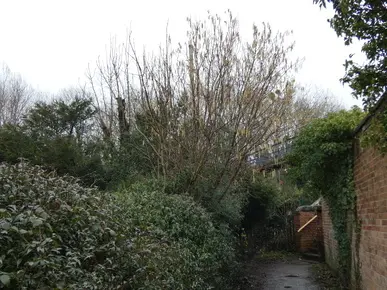 – Leominster – There have been few days without rain for the past month. Today it is barely raining but the sky remains grey. Areas of high pressure over north-eastern Europe which have been blocking the low pressure coming off the Atlantic. The Atlantic depressions have stayed motionless over the west of Britain depositing large amounts of rain, causing extensive flooding. The high pressure systems are now supposed to be moving away to the south east.
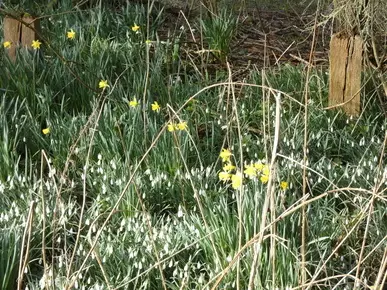 Back over the railway. A Wren sings in the garden of the White Lion and a Dunnock joins it from the yard opposite. A Blackbird cleans its beak on a Hazel branch. Above grey clouds drift south eastwards. Above them, cirrus clouds are striped with vapour trails. Into Pinsley Mill. One of a pair of Magpies chases off a Jackdaw. Blue Tits chase to and fro. Fresh vapour trails have been created by the Paris to Atlanta Airbus and the Manchester to Marrakesh 737. Four Magpies are at the end of the Millennium Park. Nearby daffodils have come into flower. The River Kenwater still flows rapidly, the surface swirling. Bell practice commences. Chaffinches sing in the churchyard. The fallen Silver Birch has been sawn to form a seat. A Blackcap is singing. A Greenfinch calls.
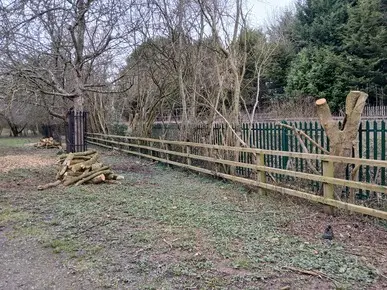 Thursday – Home – Yelping gulls drift side to side in the wind as they head south. Some clearance was undertaken in the orchard along the railway fence but unfortunately I could not make it that day. However since then someone has been here with a chainsaw and pollarded some trees. Logs are stacked up at the base of some of the apple trees and large piles of chippings are on the ground. Rain is in the air. A Robin sings. All apples have fallen and rotted now.