Monday – Leominster – The heat wave has well and truly gone now. The sky is covered in grey clouds and cool southwesterly wind blows. Along Hereford Road and on to the footpath that leads to Cockcroft Lane. Half of the large field running the hillside beside the path is covered in fine mesh fabric. A cereal crop is on the other field between the path and the primary school. Sun Spurge and Fumitory flower beside the path. A Carrion Crow stands at the top of a Silver Birch behind the school.
Onto Cockcroft Lane. Skylarks sing overhead. A Red Kite drifts across the ridge. Broad beans grow in the big field to the west of the lane hedgerow. Yellow rogue oil-seed rape flowers are dotted throughout the beans. The view towards the Black Mountains is fairly clear and very green. However, that towards the Radnor Forest looks like rain is falling. A few pure white Field Roses flower in the hedgerow. Little pink Field Bindweed peep out of the grasses.
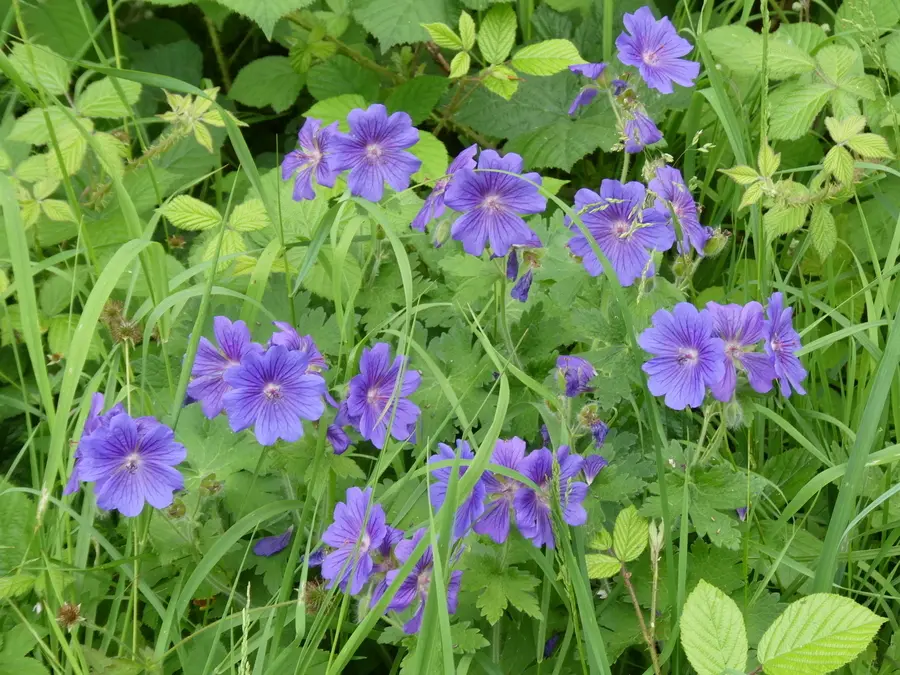
Onto the path that is still Cockcroft Lane. Here are large displays of delicately pink Dog Roses. Below is the richer pink of Herb Robert. A Chiffchaff calls, a Goldfinch and a Dunnock sings. A couple of clumps of richly purple Bloody Cranesbills flower on the large mound in the field. Further on, a Blackcap alternates between a burst of song and its tapping call.
Home – First thing this morning I used a rather excessive amount of sealant on the hoses that lead from the chicken house guttering down-pipes to the butts. This proved timely, as by mid-afternoon it is raining steadily and the butts are filling up nicely.
Tuesday – Home – The rain did indeed fill the butts and soak the parched soil. The tray of beetroot seedling is planted out. Another couple of courgettes are planted into spare spaces. Two aubergine seedlings are potted on. The final tomato plant is put into the greenhouse bed. The roses on the western wall are sending out long shoots which are pruned back. Cleavers and bindweed are in the bed below and removed although they will be back. Broad beans need too fill out a little more and they will be ready for cropping. The bolting stems on the chard are cut off and fed to the hens. The plants should continue to produce leaves for a while yet. Later a couple of rows of carrots, Paris Market, are sown.
Cheeps and chirps of young birds are everywhere. A Goldfinch is singing high in the Ash tree. Showers of rain move through followed by a burst of sunshine before the next clump of cloud arrives.
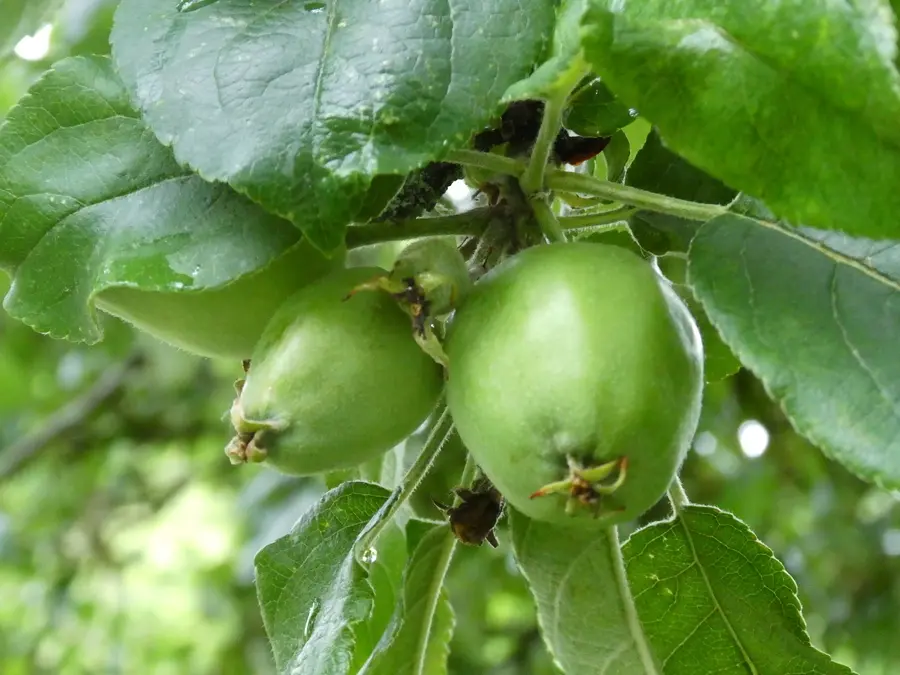
Wednesday – Leominster – A cloudy day, threatening rain and rather muggy. Down to the Millennium Park. A couple of Blackcaps are singing around the orchard area. Wood Pigeons call. Tiny green four-lobed fruits have appeared on the Spindle tree. Although it is not easy to tell, it looks like the apple crop may be limited this year.
Meadow Cranesbills and Ox-eye Daisies are flowering in the park. A Dunnock sings and a Blackbird chinks its alarm call. Much of the park is now rough meadow. Hogweed and Stinging Nettles make it impossible to see the old pond any longer. The Peace Garden is succumbing to Stinging Nettles. It is a great shame that this area is subject to such neglect. I am unclear how this situation has arisen. It seems that the grounds maintenance was handed over by either Leominster Town Council or Herefordshire Council to Grange Court. However, Grange Court has no source of finance to undertake any work, so either they tried to hand it back to the Council or request payment, neither of which has happened. The result is no-one takes responsibility for the Millennium Park and only a few of us, as volunteers, try to keep the orchard area under control.
Thursday – Cardiff – We catch the train to Cardiff. There has been the threat of rain but it seems to have passed by the time we arrive. The station façade never fails to impress, a large stone frontage with “Great Western Railway” emblazoned across it. Into St Mary Street. The Pierhead clock is in a glass box on the street. It had was constructed by Potts of Leeds and installed in the Pierhead building in 1897. It was restored by Smith of Derby, who now own Potts, and unveiled here on Tuesday November 8th 2011. As the clock strikes, three monkeys swing on its mechanism and use a hammer to ring the hour bell. The monkey design was originally conceived by the Third Marquess of Bute as a direct, satirical rebuttal to Charles Darwin’s Theory of Evolution. These brass monkeys were added by the artist Marianne Forrest when the clock was restored. This corner was the site of the South Gate of the city walls.
On the junction and into St Mary Street is the Royal Hotel, designed by C. E. Bernard and built between 1864 and 1866. On 13th June 1910, a fundraising dinner was hosted by the Chamber of Commerce for Robert Falcon Scott’s ill-fated expedition to Antarctica, which sailed from Cardiff two days later. Across the road is the Royal Arcade, the oldest arcade in Cardiff, being built in 1858. It houses independent and niche shops, tea, whisky, posh frocks etc. At the other end is The Hayes. The Central Public Library stands here, now the Museum of Cardiff. The building was opened in 1882 as the Cardiff Free Library, Museum and Schools for Science and Art, which included an art gallery. The design was by architects James, Seward and Thomas, and the building was erected between 1880 and 1882 for just over £9,000. The museum is very “interactive”, not necessarily to my taste. However, there is a beautiful corridor, the original entrance to the building, lined with ornamental wall tiles, by Maw and Co of Jackfield, Iron Gorge, designed to depict the four seasons and night and morning.
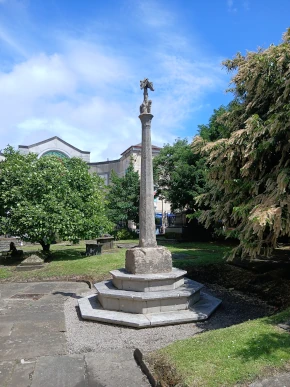
On up The Hayes. St John’s Gardens, originally part of a graveyard, has some fine specimen shrubs and trees but needs a lot of weeding. Beyond is the church of St John the Baptist. The church was built in 1180 as a chapel of ease for the larger St Mary’s Church, itself founded by Benedictine monks from Tewkesbury Abbey. It was sacked during a rebellion of Owain Glyndŵr in 1404 and rebuilt in the second half of the 15th century and given a perpendicular tower with a peal of ten bells. This is dated circa 1490 because of the similar Jasper Tower of Llandaff Cathedral which was built at this time. The organ was built in 1894 by “Father” Henry Willis. The Herbert Chapel has a Jacobean monument of, unusually, to two brothers: Sir John and Sir William Herbert. The reredos by Sir William Goscombe John was carved in 1891-2. The glass windows in the north chapel date from circa 1855, with references to the Bute family. Those in the north aisle are by Morris and Co, with individual saints being designed by Morris, Burne-Jones and Ford Maddox Brown. Outside is the mediaeval preaching cross, with a worn carved top of the crucifixion and saints.
We return down St Mary Street to Caroline Street where we have an excellent lunch in a tiny Asian barbeque restaurant. After a couple of fairly pointless visits to large national stores, we have a couple of pints (at city prices) and catch the train home.
Sunday – Leominster – Another grey morning, cool but milder than yesterday. Across The Grange where a young Blackbird is rapidly flicking its wings at its parent who is feeding it invertebrates pulled out of the grass. Into Pinsley Road. A Goldfinch sits on a wire. A Blackbird sings loudly. Past the old school. A Blue Tit is in the trees seemingly manic as it dashes to and fro through the branches seeking insects. Over Priory Bridge. The water level in the River Kenwater has risen slightly following the rain in the last few days. There must have been rather more water earlier in the week as the large branch that was in the middle of the stream last week has now gone. On to Ridgemore Bridge. The water level in the River Lugg remains low. A Chiffchaff is in a Field Maple overhanging the river. The tree has numerous winged fruits. Over the road, a red-flowered Horse Chestnut has small furry Conkers. A Chaffinch sings loudly. A Cormorant flies south, high over the A49.
The wooden construction by the bridge over Ridgemoor Brook had been dismantled. The market is much smaller this week. Back to Paradise Walk. A Chiffchaff calls much less stridently than its earlier spring call. Umbellifers flower all along the edge of the river.
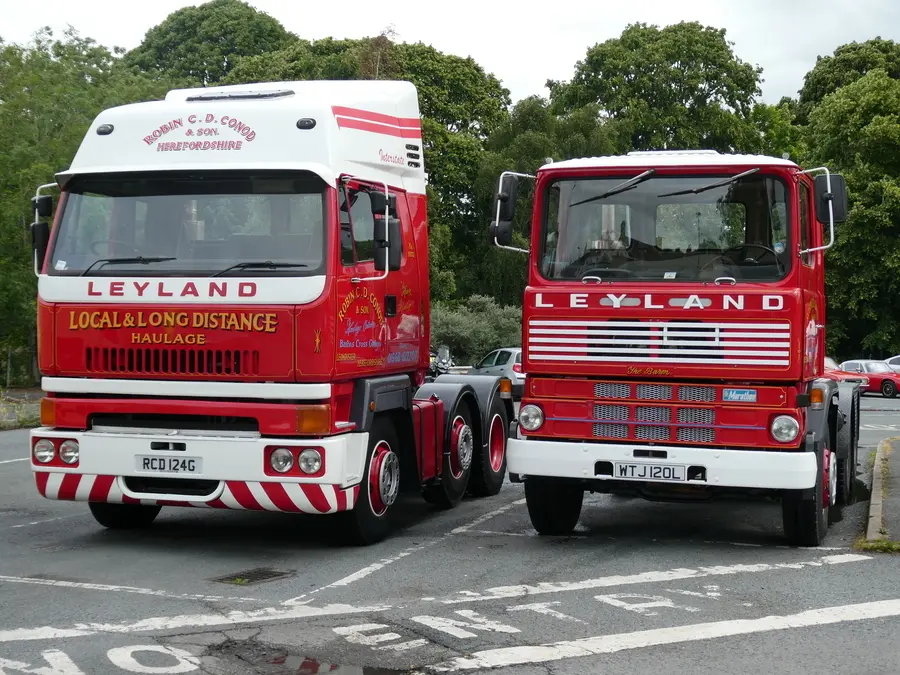
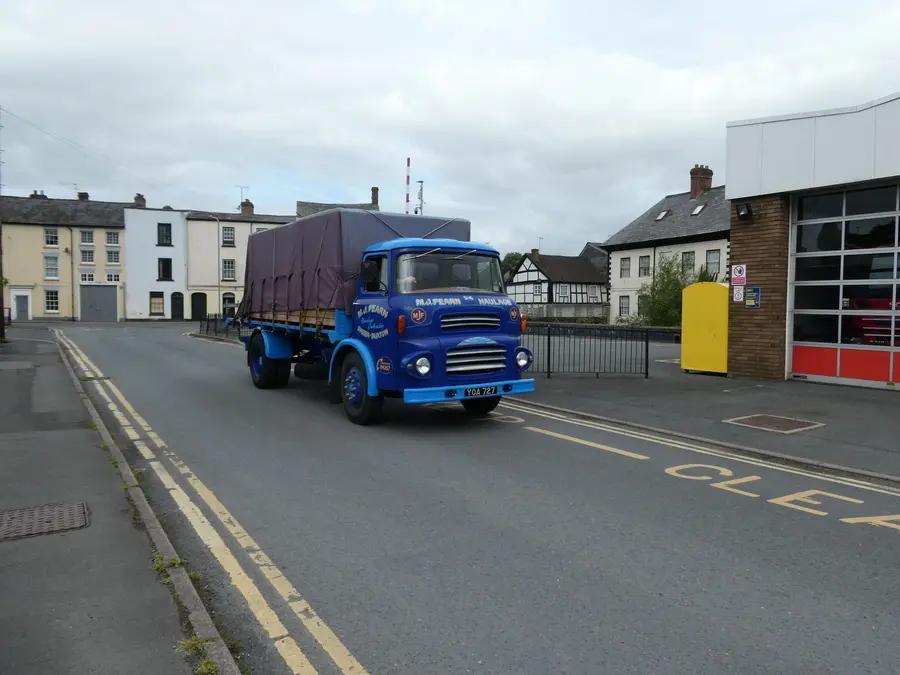
The festival vintage and classic car rally is being held in Bridge Street car park. As well as classic cars, several mid-century heavy goods lorries growl up.
Home – I sieve some compost from the big bin. It is good quality. Some sand and vermiculite is mixed in a trays of cabbage and kale are sown. Another row of mange tout peas are sown in the bed along with some spring onions. Yesterday afternoon three more canes were fixed in the greenhouse bed and another three tomato plants are planted. As usual I have lost track of what tomato plants are where, no matter we will hopefully find out in a couple of months. Kay is doing an heroic job emptying and sieving the leaf mould bay. I trim the vines against the wall to stop them climbing up into the trees.
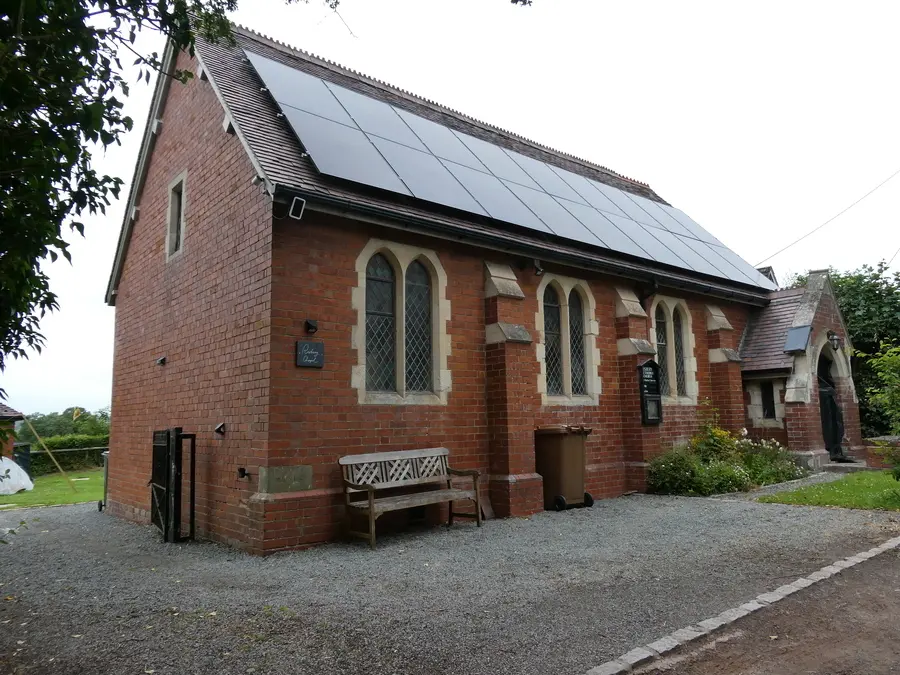
Monday – Llandeglau/Llandegley – A small village at the eastern end of the long ridge of Llandeglau Rocks. The village is by-passed by the A44. Blue sky is showing briefly through the grey clouds. The temperature has dropped over recent days. A large farm and several houses are on the far side of the junction with the main road. By the small road through the farm are stone barns, one with steps leading to a hay loft. Opposite is a house on the site of the smithy and Burton House, built in the 17th century and added to in the 19th century when it became the Burton Arms pub named after Edward Burton of Shrewsbury. It was a coaching inn and a stopping place for sulphur springs which are across the fields towards Mithil Brook. Beside it is the church of St Tecla of Iconium.
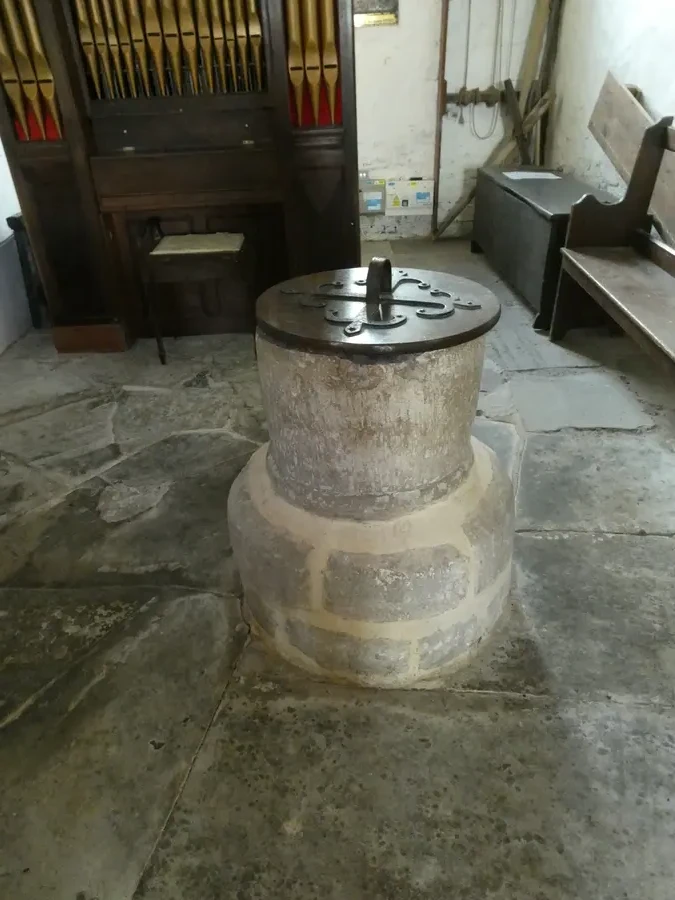
St Tecla was a companion of St Paul. The dedication is probably due to the fact the site had a reputation as a healer and the sulphur springs. The church dates from the 12th century. The first recorded vicar was Geoffrey Applepen in 1401. It was significantly restored in 1876 by S W Williams, architect of Rhayader, who added the chancel and at the same time a vicarage (a very large house some distance up the A44– and church school were built. The entrance to the porch looks rather like the entrance to a barn. The tower was rebuilt in 1953. It has a single bell dated 1630. A single manual pipe organ stands in the chancel. The font is a typical Norman tub type. A chest with two carved panels is beside the organ. The east window is dated 1897 by Jones and Willis of Birmingham and London. One side window in the chancel is dedicated to Major General Robert Children Whitehead by his widow. As an Ensign in the 97th Regiment Whitehead served through the Crimean War, and was at the storming of the Redan in 1855. He was then mentioned in despatches, and received the Crimean Medal with clasps for Sebastopol, also the Turkish Medal and the fifth class of the Medjidie. He commanded the 58th Regiment through the Zulu campaign after the disaster at Isandhlwana, and was present at the Battle of Ulundi. Colonel Whitehead was again mentioned in despatches, and has been rewarded with the Companionship of the Bath. In 1908, he was appointed the High Sheriff of Radnorshire. The other is dedicated to Emily Augusta Severn, who was known as a philanthropist, by Sarah Ann Whitehead. They are both early 20th century and also by Jones and Willis. Stairs lead to what seems to be a modern or well restored minstrel gallery with a door in it leading to the tower which is splattered with droppings. The last resident vicar left in 1949.
In the churchyard is the grave of J Morgan-Evans, a highly regarded Spa Physician of Llandrindod Wells, who died in 1938 and John Evans, Surgeon, who died in 1891. nearby is an ancient Yew tree, hollow with a number of dead trunks high in the air. However, there various clumps of small leaved branches and the remains of the main trunk. A Song Thrush sings in a clump of trees in a sheep paddock below the graveyard. A group of chest tombs are near the tower but overgrown with vegetation and no sign of any inscriptions.
Across the road is the old church school, now a residence. Beside it is a long, low cottage, Yr Friallen, believed to have been built in the 19th century. I decide to try and find the sulphur spring. A footpath sign points through a gate and along a field of long grasses, buttercups and sedge. Everything is soaked and very soon so am I. It seems the possible site is a lot further through this saturated field so I decide to give up and squelch back to the village.
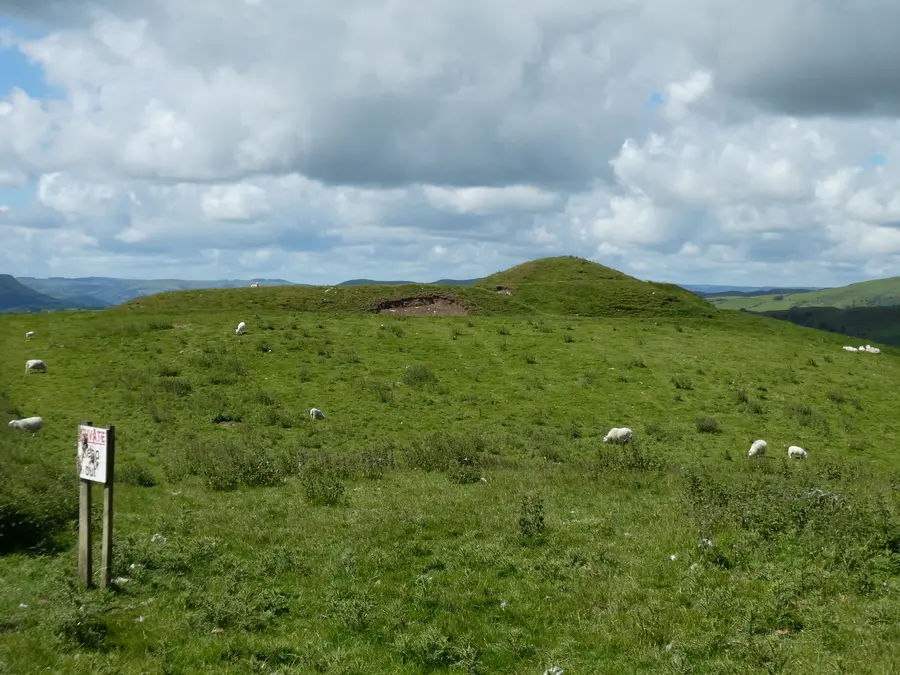
Back along the A44 and up the winding road towards the Builth Wells junction. Into a lay-by and then a walk back down the road. A gate looks out over a field and beyond is the motte and bailey of Castell Crug Eryr (Crug Erye meaning “The Eagle’s Crag”). The site commands the Edw valley. It is believed the castle belonged to the princes of Maelienydd, as Maelgwn ap Cadwallon, “Prince of Melenia” (i.e. Maelienydd), son of Cadwallon ap Madog, received the Archbishop of Canterbury at Crug Eryr Castle in March 1188 when he was accompanied by Gerald of Wales, (who called the site “Cruker’s Castle”) on a tour intended as a recruiting campaign of the Third Crusade. The herald-bard Llywelyn Crug Eryr lived here in about 1300. It probably went out of use later in that century.
Thursday – Humber – What should be the second Breeding Bird Survey of the year, but the earlier one was not undertaken because of my hip replacement. A dull cool morning. Rain starts to fall. Skylarks are singing high overhead. Hedges are full of cleavers; in places the plant forming the hedge cannot be seen under the tangled stems and leaves of the Cleavers. Dog Roses are in flower. A Common Buzzard takes off from a telegraph pole. The rain becomes steadily heavier. Down the lane beside the green burial ground. Two Wrens fight on the tarmac at my feet. Over a dozen Lesser Black-backed Gulls lift off from the field opposite, there are a good many more flying around the general area.
The village is quiet with few Jackdaws, the usual source of noise, around the church. A single Swallow is slumped on a wire in the heavy rain.
Friday – Risbury – The dark, threatening clouds of early morning slowly dissipate. There is a strong wind blowing. From the Humber woodland burial ground I head south down the Roman Road. A Chiffchaff calls, a Wren erupts into song and a Carrion Crow caws. Hoverflies, flies and White-tailed Bumblebees work their way through the umbels on Hogweed. Heath Farm has a number of residences, a fine stone farmhouse, Heath House, barn conversions and relatively new builds.
On down the road. A Blackbird and Chaffinch sing. Witsets farmhouse has been added to at various times and the surrounding barns converted. Large old Oaks and Ashes stand behind the roadside hedges. A Rabbit scurries into a broad bean crop. Sunnybank farmhouse is 20th century. A bumblebee visits Field Roses in the hedge row. A Blackcap makes a stuttering call. A 17th century timber-framed cottage, Hollywall Croft, is a holiday let. Risbury Bridge crosses Humber Brook. Opposite is a very large pond and beyond Risbury Mill, a 17th century house, with later alterations, on an earlier site. The mill, with most of its equipment still intact, is beside the house. White geese graze on the grass. Another track leads to Risbury Court and hop kilns. Behind the buildings are the bramble covered ramparts of Risbury Iron Age hillfort.
The road climbs to a junction, there Roman road continues to Bodenham, I take the lane to Risbury village. The road drops down to a bridge over a very small stream which heads for Humber Brook. It then rises past a partially timber frame house, Lowbrook, 17th century with later alterations. Past the old school and master’s (sic) house, built in 1894. Into Risbury. A rest in the bus shelter at Risbury Cross. The dwellings are mainly modern. A few House Martins fly over the roofs. House Sparrows chatter around the buildings. A large flock of Jackdaws rises from a field in the distance and breaks up. Fine rain starts to fall. Towards the east end of the village is the Methodist Chapel, now a residence. It was built towards the end of the 19th century by John Riley who lived at Great Marston Farm. The chapel was closed in 1914. A tractor pulling a rather ripe load of manure passes. Chaffinches and Greenfinches call.
Back down towards the Roman road. Up the road to Humber. A pair of riders on large horses with feathering on their legs then a couple on a tandem pass.
Wednesday – Leominster – Rain fell overnight and continued into the morning. It now seems to have almost ceased. The lack of wind means there is a muggy feel to the air. Down to the White Lion. The bridge over the railway to the River Lugg is still closed. A Chaffinch and Wren sing across the railway. House Sparrows feed on the footpath. A Class 67 diesel pushes a south-bound train into the station. Small green blackberries cover the Brambles, it looks like there will be a bumper crop.
Into the Millennium Orchard. Hogweed is in flower, some stalks over six feet tall. They are interspersed with Meadow Cranesbills. Apples are forming on the trees. Ox-eye Daisies, Knapweeds, Hawksbit, Red Clover and more Hogweeds and Meadow Cranesbills flower on the meadow but Stinging Nettles are encroaching every year. The River Kenwater is still very shallow and clear. Trees appear to be toppling around the old pig pen on Pinsley Mead. The temperature and humidity are rising.
Work is underway to restore the Georgian house in Church Street which had fallen into a considerable state of disrepair. Scaffolding is being erected and workers are inside dealing with the crumbling plaster.
Friday – Pendock – The morning is warm with a fair covering a cloud although blue sky can be seen. A lane comes off of the main road from Ledbury to Tewkesbury and passes a very large former rectory, built in the late 18th century on an older site. A track now leads to the old Pendock church. A short distance across a field is the noisy M50. On the other side of the track is a very large field full of two foot high maize plants. Cow Parsley, Nipplewort, White Campion, Field Poppies and Field Bindweed flower beside the track. The Field Bindweed, some of which is edged in pink, others pure white, is being visited by a Small Tortoiseshell butterfly. A Skylark sings overhead. To the west the horizon is filled by the Malvern Hills. A herd of cattle in the field alongside the motorway gallop past then gather near the church to see what I am doing! Just before the church gate is a patch of Black Horehound, also known as Stinking Roger, in a larger patch of Stinging Nettles.
Through a kissing gate which has a tall extension and a hook presumably for a lantern. A sign warns that “Badgers have been busy in the churchyard. Be careful”.The church dates from around 1170 with alterations and additions in the 14th and 15th century. The church is simple; a nave; a short chancel and at the other end the bell tower. Any dedication is said to be unknown, although early OS maps refer to it as the Church of the Redeemer. Doors either side of the nave have Norman arches and chancel arch and the bell tower arch are both early English. The font is a simple bowl of the 10th century, suggesting an earlier church here. The glass looks Victorian. The organ is a Georgian chamber organ that was restored in 1978 by Nicholson & Co of Worcester. It is thought that Sir Edward Elgar may have played it. There is a ring of four bells. The oldest is dated 1686 by an unknown maker; there are two bells by Abel Rudhall, one cast in 1745 and 1753, and the fourth, originally of 1745 was recast in 1908 by H. Bond of Burford. The walls are painted white, they cover wall paintings, which were recorded in the early 1940s by Miss Elsie Matley-Moore. A bronze wall plaque is dedicated to Sir Joseph Dalton Hooker (1817-1911) sometime director of the Royal Botanic Gardens, Kew. Three wooden plaques depict the Lord’s Prayer, the Ten Commandments (dated 1851) and the Creed. The church is disused and under the care of the Churches Conservation Trust.
To the east of the church the foot path should continue but crosses long grass towards Priors Court, now called Pendock Hall. Again, early OS maps mark here as a priory, but there seems to be no modern record. It is likely this refers to Priory Court and the village being closely associated with Worcester Priory. To the north of the churchyard is the site of the mediaeval village and possibly the manor house of Urse D’Abetot. I head back to the beginning of the track. A pair of Marbled White butterflies fly past.
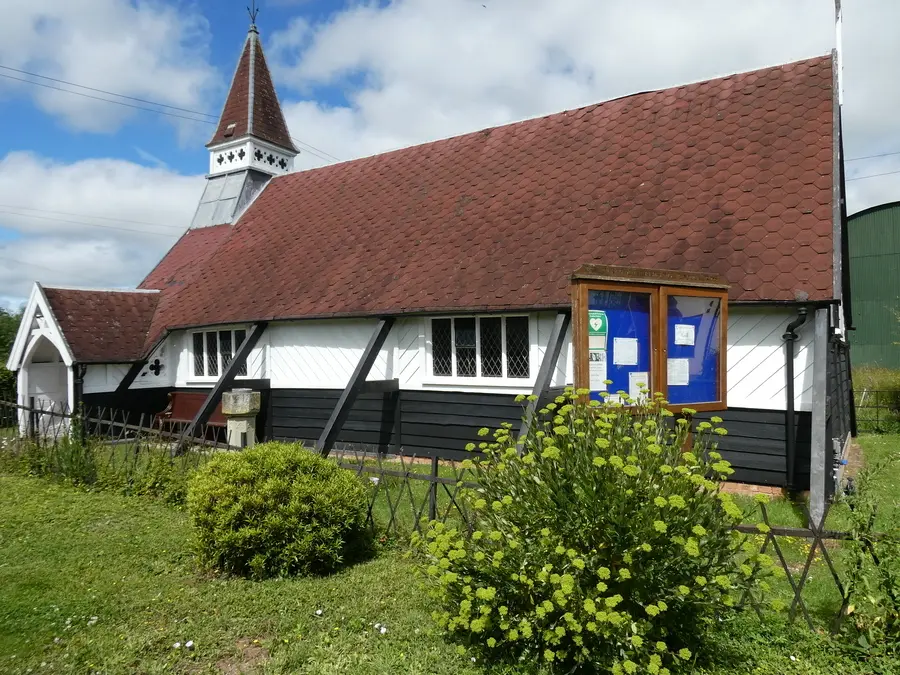
I drive along a lane parallel to the motorway. Fisher House was built in 1909-1910 for George Oakley Fisher, the grand, baronial-style house was designed in the distinct Arts and Crafts architectural style. It has the prominent coat of arms of the Pendock family on the gable. For many years, the estate housed Berrow Wood School, an independent residential school that operated until the early 1990s. Another large Georgian house is Underhill Farm. Then into Pendock which is split either side of the motorway. The name is derived from the old Welsh words Pen meaning hill and Heiddiog meaning barley. On the North side the houses are mainly modern with a modern school. Over the motorway to a crossroads. On one side stands the old forge and opposite Pendock church, a former mission church, built entirely of timber, in 1889 to the designs of W J Hopkins.
A few miles down the road is Gadfield Elm chapel. It was built in 1836 by the United Brethren, a small break off from the Primitive Methodists on land purchased for £25 under the direction of Thomas Kington. In 1840 Wilford Woodruff, a Mormon, met with the United Brethren and all of the latter joined the former. The chapel was sold in 1842 to finance the emigration of the new Latter-day Saints to the United States. It was then used as a barn and eventually fell into disrepair. A local group of Latter Day Saints purchased property in 1994 and restored it. Access is behind a locked door, the code of which is answered by 6 questions referencing the Mormons.
Eldersfield – Through some back lanes to Eldersfield. The old school house is undergoing major restorations including sandblasting the walls leaving them somewhat excessively bright. Into the village to the church of St John the Baptist.
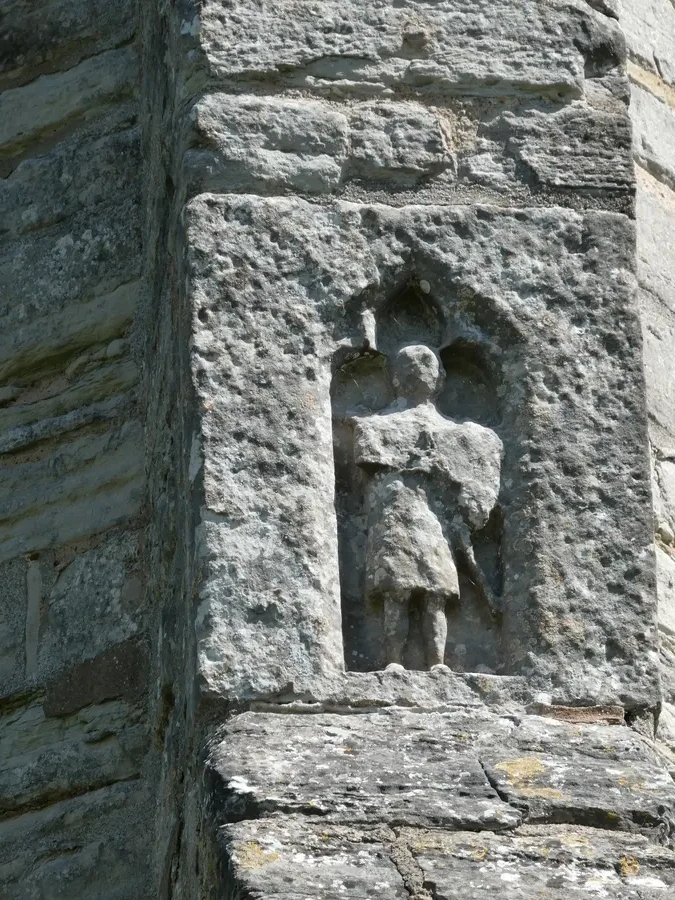
The church is 12th century although just the chancel arch and the doorway remain from that building. The north aisle, tower and spire are 14th century and in the 15th century. Thomas Holford added the chantry chapel. On the south side of the nave are windows depicting the arms of the Berkeley family. There was considerably more heraldic glass here but it was destroyed some time between 1629 and 1780. The oak pulpit is 17th century. The font is 15th but re-tooled and is octagonal with a shield of arms carved on each face, one of which is the Whittington family, famous for one Dick Whittington. On the north aisle is a modern window for the Millennium. By the font is a floor plaque to William Underhill, who served in the courts of Queen Elizabeth I, King James I and King Charles I, dying at the age of 70 in 1647. There is a ring of six bells by Abraham Rudhall of Gloucester, 1705, but two were recast by Taylor & Co of Loughborough in 1891. On the buttress of the tower is a small effigy of a night possibly a Templar as the Knights Templar owned land in this area. A number of early 18th century chest tombs are in the churchyard.
Across the road from the church is the village pond. Beside it is a 17th century timber framed pigeon cote. Eldersfield Court stands nearby. To the east of the church are several early 17th century barns, now converted. To the east of the village is a thickly wooded hull concealing an Iron Age hill-fort. It is a large univallate hill-fort, probably of national interest but has had hardly any archaeological investigation and appears to be inaccessible to visitors.
Sunday – Leominster – The sun is bright first thing in the morning, early as it is the summer solstice, and the day starts to heat up. Across the Grange and down to the Priory Bridge. The water level in the River Kenwater is low. Along Paradise Walk. Several Blackbirds are in song. A Chiffchaff calls a weak version of its spring song. Beyond Paradise Bridge, a long Privet hedge is in flower filling the air with its musky scent.
The market is large and very busy. However there is nothing there that I want to buy. I retrace my steps, going up the Priory and onto the Grange. The outdoor yoga session is being set up.
Home – Watering is becoming a daily affair. Pots and troughs dry out rapidly. Yesterday I “fitted” some mesh over the guttering along the chicken run. The kit has no instructions and I fail to fathom out how it is supposed to work. However, the mesh is over the gutter and that will have to do. It should keep the leaves and apples from the Gladstone apple tree from blocking it.
This morning the broad bean, potato and courgette beds are weeded. There are obviously hundreds of callaloo seeds in the compost used to dress the bean and courgette beds and now hundreds of seedlings have appeared. I let some of the largest in the bean bed keep on growing and scrape out rest, which are fed to the hens. A couple of trays of basil are sown. Several pounds of broad beans are harvested. Some of the potatoes are showing signs of blight so the leaves are removed. One plant is looking a bit pathetic, so it is dug out and four small Red Duke of York potatoes are picked.
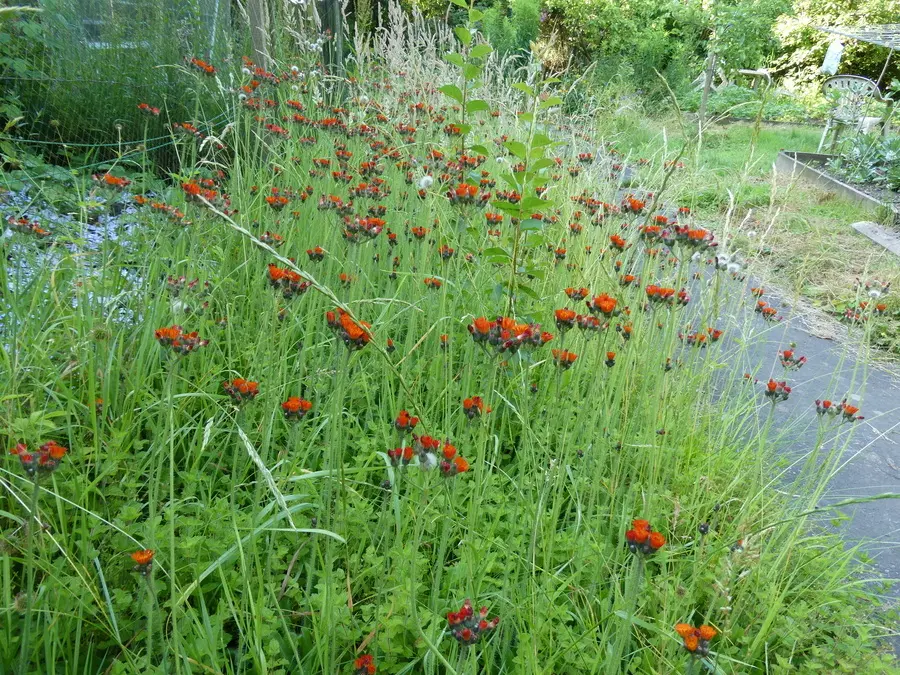
The garden slowly changes. The Rambling Rector rose is beginning to come to the end of its flowering but the pretty pink rose on the bower we had made some years ago is just beginning to bloom. On the meadow, Yellow Rattle are turning brown with large seed pods, Ox-eye Daisies are in flower, a single Meadow Cranesbill is in flower and the mass of Black Knapweeds will flower soon. There are too many of these and some have fallen over, so I need to thin them. Orange Hawkweed, a beautiful rich orange colour, is proliferating the grassy areas of the garden.
Monday – Barton on Irwell – A row of cottages, Templeman Terrace, built in the 1870s leads to a low bridge, Barton Aqueduct, carrying the Bridgewater canal. Yellow and black striped barriers hang over the road to stop over-height vehicles which would hit the aqueduct. Near the road junction is a filled in arch of an earlier aqueduct built by James Brindley. There is not a great amount of information about the aqueduct, it is not listed and was built, presumably at the same time as the Swing Aqueduct.
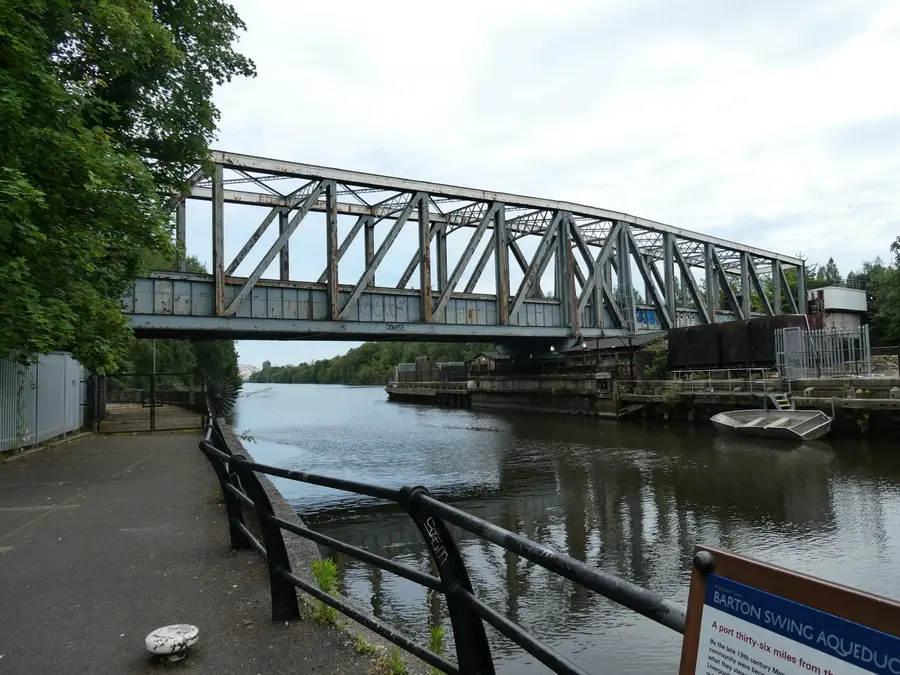
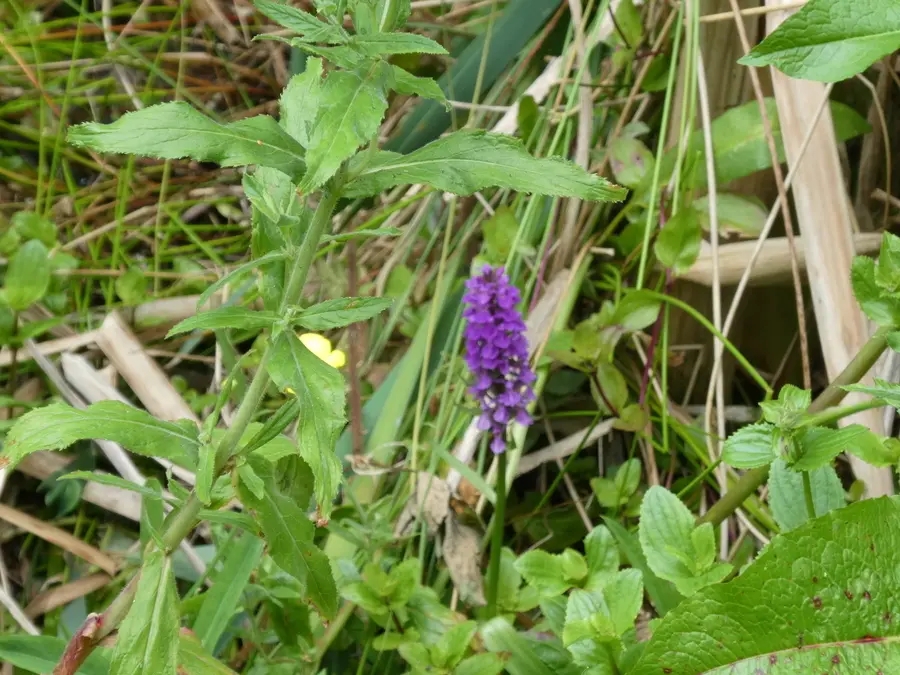
The Barton Swing Aqueduct was designed in 1893 by Edward Leader Williams, who also built the Anderton Boat Lift, to take the canal over the new Manchester Ship Canal. Barton was a small village close to a ford across the River Irwell. The Bridgewater canal brought industry, housing, inns and churches. Into Pocket Park which lies beneath the large stone walls of the aqueduct. A wooden boardwalk carries the path over marshy ground, with many bright yellow Common Monkey Flowers and Greater Spearwort and rich purple Marsh Orchids, to the Manchester Ship Canal. The Swing Aqueduct, the first and only one in the world, rotated through 90 degrees with gates at each end which kept in 800 tonnes of water. Just downstream from the aqueduct is Barton Road Swing Bridge. Both bridges are controlled from a tall red brick tower on the island on which the aqueduct pivots.
A short distance along Barton Road it runs alongside the canal. A large old commercial canal boat is rusting by a scrap yard. On the other bank is an old dockside crane. Across the road are modern buildings clearly on the sites of older large houses. One block of apartments is called The Manse. Outside another is a large tombstone to Henry Hall who was involved with the Wesleyan chapel in Barton. The area has a strong scent of something like fabric softener which turns out to be a number of flowering Lime trees.
I head north past modern housing and mainly 20th century industrial units. Many are on the side of mills, foundries and a school is on the side of a large workhouse. There were also extensive railway networks across the area, nearly all now gone.
Monton – On Monton Green is the Monton Unitarian church. A chapel was built here in 1697 following the passing of the Act of Tolerance 1689 but was destroyed during the Jacobite Rebellion of 1715. It was rebuilt soon after the compensation from the government. Thomas Siddall of Slade Hall, Manchester and four others were executed in February 1716 for their part in the Rebellion. The present church was built in 1875. There is a fine set of windows but the church is, of course, locked.
Bolton – Halliwell – I am staying in a flat above a closed florist shop - all a bit strange. Across the road is St Paul’s Place. It was built by J.H. Ainsworth, owner of a large local bleach-works in 1847, St Paul’s Church with St Paul’s-place running parallel with the church on either side of it. Church, school and houses are all of the same date, and doubtless the houses were intended to accommodate people employed at the bleach-works. The two rows of houses are known collectively as St Paul’s Place, one of them being named after the Queen and the other after her Consort – Victoria and Albert. Nearby, Falcon Mill, a cotton mill built in 1903 by G Temperley stands behind shops and houses, towering over them.
Onto a bus into the centre. I intend to explore here tomorrow. There seem to be a good number of typical Victorian buildings of high stature, banks etc. But none of them are still banks unsurprisingly. Past a large bronze statue of Sir Fred Dibner, a demolition expert who became a household name. Into the Old Man and Scythe pub, reputed to have been rebuilt in 1636, though the present building is very much an early 20th century remodelling with mock timber over a genuine timber frame. However, it sells a decent pint! I walk back to Halliwell to The Stork pub, a mid Victorian establishment and another good pint.
Tuesday – Bolton – The day is already warming. Along Halliwell Road. The Crofters Arms had cells in the basement as a police lockup. A large red brick building has ornate red tiles, once a club with a bowling green behind it. Up Wordsworth Street. Terraces of 19th century houses run off each side with the back street behind their small yards. Most streets still have cobbles. St Augustine Street leads to Eskrick Street and the church of St Thomas the Apostle. It was built in 1874–75 to serve the growing local population, and was designed by the Lancaster architects Paley and Austin. The main benefactors were the Cross family, mill owners, The church was built almost entirely of brick, with minimal stone dressings, and has green slate roofs with a louvred bellcote which has a pyramidal roof forming a dormer. It is locked. Next to it is the church school, also paid for by Cross and much enlarged since. Houses here are dated 1889. Further along the street is the Makki Masjid mosque, a modern building attached to an older one, the former vicarage (another Cross benefit). Past Brownlow Fold Community Learning Centre. A large old bulldog pants past. Eskrick Road slopes down and the houses are now mid to late 20th century. A large recreation ground of Bolton Rugby Club is on one side and the large Mortfield Lodge reservoir built around 1860 on the other although it appears to be inaccessible. Next are some well kept allotments.
At the end of the road it joins Chorley Old Road. Opposite are Nortex and Columbia cotton mills, now different retailing outlets. A short distance up the road is the former Victory hotel, now housing several eateries. Terraces of houses in the street date from the mid 19th century. The Chorley Old Road meets the Chorley New Road at a large junction. Down a small cul-de-sac are four pillars, former gates of the Bolton Infirmary, now blocks of apartments. Chorley Street descends a gentle hill to the River Croal. It is shallow and flowing slowly. On the north side are two stone arches below the road bridge whose use is unclear. The Bolton Lads and Girls Club stand on the site of a large timber yard. White Lion Brow climbs to Spa Road.
St Paul’s church, built in 1862-3 by James Murray of Coventry, architect, on a large junction looks disused and possibly converted into apartments. The attached school is now a GP practice. Next to the church is a large modern block on the site of Bolton Brass Works. Across the junction in Marsden Road is Diamond Jubilee Buildings of 1897. Opposite a large modern block is on the site of the former Fire Station. In St Edmund Street is St Edmund’s Catholic church, temporarily closed for over three years now. The presbytery is in poor condition. Car parks are on the site of an iron works and St Helena cotton mill. A bridge of 1902 crosses the River Croal. Beyond is a large arched skew bridge carrying Marsden Road over St Helena Road.
Back up to Deansgate. The large stone built Post Office in a Renaissance style built in Darley Dale stone from the Stancliff quarries. The contractors were Smith & Sons (Burnley), Ltd, Burnley, and the C P Wilkinson, of H.M. Office of Works. It closed in 2018. Opposite a modern block has obliterated the Empire Theatre, Queen Street, several pubs and a school. A large cream marble building was a bank, now apartments. On the corner of Old Hall Street is a large timber-framed building of 1912 with a tower marked “Whittakers” and a stone dome, a menswear shop. Opposite is a red stone and marble bank building, still a bank! A large junction, where red brick Victorian Palatine Buildings, early 20th century Knowsley Buildings and an Art Deco building on each corner are all national fast food chains.
Here is Fred Dibner’s statue and a Corliss steam engine from a silk mill in Bentham, Yorkshire. Beyond is Victoria Square. Bolton Town Hall faces the The Cenotaph. The Town Hall was built between 1866 and 1873 for the County Borough of Bolton to designs by William Hill of Leeds and George Woodhouse of Bolton. The cenotaph was designed by A J Hope and constructed from Kemnay granite. It features a tall pylon in the Neoclassical style, penetrated by an arch that frames a bronze cross overlaid with an inverted crusader’s sword. The structure stands on a moulded base with inset steps and is flanked by two projecting pedestals. It was unveiled in 1928. In 1933 bronze sculptures by Walter Marsden were installed on either side of the arch. Behind are some very boring modern units. Statues either side of the Town Hall steps are of Victorian dignitaries, Lieut. Colonel Sir B A Dobson, textile machinery manufacturer and mayor and Samuel Taylor Chadwick, a doctor and philanthropist.
The former public library stands at the start of Newport Street, a long modern parade of shops leading to the transport interchange. A large arch stands over the railway bridge. Back up Newport Street and round behind the Town Hall. A great crescent, Le Mans Crescent (named after Bolton’s twin-town), containing the Museum, Art Gallery, Aquarium and Library was an extension in the 1930s to the designs of Bradshaw, Gass and Hope. The museum is full of excited school children but is still interesting. Past the Octagon,a modern theatre. Around the corner is Elizabeth Park and opposite Bolton market. The outside stalls are exclusively clothing and fabric, most aimed at the Asian market. A large box of huge watermelons is pulled out of a lift. The meat and fish stalls inside are real “nose to tail” foodstuffs, goat tripe, cow ears, sheep lungs.... And the prices are ridiculously cheap compared to home!
Back to Deansgate past the Crown Court, designed by the Property Services Agency and completed in 1982 is a concrete modernist, either monstrosity or classic depending on ones taste (Pevsner did not approve!) Onto Marsden Road and over the bridge seem from below earlier. It was built in 1876. Into Vernon Street. A familiar screech vibes from high overhead, one of the Peregrine Falcons that nest on one of the churches is circling. It is not clear the Royal Hotel is still in business. Modern houses are overlooked by Vernon cotton mill. Plaques in a wall record that the new housing estate beyond is on Moss Field mill owned by John Knowles, 1862 and seemingly demolished in 1993. A travelling grocery van stops but did not attract any customers. St George’s Indian Orthodox church is a modern building.
I am very weary, having rather overestimated by recovery from the hip surgery. It is also over 30°C and the sun blazes down from overhead giving little shade. I had planned to stay another day but decide to go home.
Wednesday – Home – The morning starts with a slight breeze but the sky is cloudless. As the day progresses it becomes hotter. The temperature inside the house rises to 26°C and stays there. In the early morning tomatoes, courgettes and the greenhouse are watered. The water level in the butts is falling rapidly now. The main flower bed is watered before the sun reaches it.
The first courgette is harvested. Then the mass of summer raspberries that have spread down the eastern side of the back end of the garden are picked. Kay usually does this and I soon realise what a heroic job she does! The tomatoes in the greenhouse are pinched out and they and the cucumbers are further tied to their stakes. It is over 40°C in here and not a comfortable job. Nationally, the record temperature for June is broken at 36.1°C in Hampshire.
Several young Blackbirds fly clumsily around the garden. Young Blue Tits and Robins are also present. Swifts scream overhead all day.
Thursday – Home – The day starts in a similar fashion to yesterday except there is no breeze. Pots are watered. Then the roses are deadheaded. Vines trimmed and leaves thrown into the chicken run. Broad beans are harvested and two young Blackbirds chased out of the fruit cage. Now time for a shower and breakfast.
By mid-morning the temperature is into the 30°Cs. I pick a few strawberries, harvest the poor black currant crop and pick some raspberries in the fruit cage. The overgrown strip between a vegetable bed and the chicken run is strimmed then the lawns are mowed. Enough is enough and I retreat for a second shower.
There is a bit of a breeze in the afternoon but it seems to be simply blowing hot air around. Swifts are screaming overhead but are so high they are almost invisible. I change the hen’s water and they decide that fresh, cool water is highly quaffable. Most plants are drooping in the heat.
By mid-evening the sun is not shining directly on the vegetable beds so I plant out the rest of the climbing French beans. They are not in the best of conditions but hopefully after a good watering they will pick up overnight. A row of broad beans also look like they are not coping so they are also watered. The temperature record was again broken today at 36.7°C in Somerset. It is still very warm and looks like another uncomfortable night’s sleep. However, a mass of thunderstorms are moving north from Brittany and they may bring some relief later in the night.
Friday – Home – 2:00 in the morning. It is still very warm, uncomfortable in bed. The southern horizon lights up and is followed by rumbles of thunder. Dozens of lightning strikes are being recorded forty miles or so south of here. Twenty minutes later the lightning is to the west of here. There is a brief shower of rain.
Another pound of raspberries are collected and half a dozen jars of jam produced. This, of course, makes the kitchen nearly unbearable with heat. Some watering is done. Kay is having a slightly worrying journey back from Brighton; many rail companies are declaring cancellations. Her train out of London is delayed as seven others ahead are in a queue. A couple are having to disembark their passengers as there are air conditioning failures. The trains that are running are rammed full. She has a potential two hour wait at Newport but we decide it is easier to catch the Holyhead train, which stops at Hereford but not Leominster, and I will drive to the city to collect her.
The temperature record is again broken today at 37.3°C in Suffolk. This was later amended to 37.7°C in Lingwood, Norfolk.
Sunday – Leominster – A sudden overnight drop in temperature. The sky is now clouded over and there is a brisk westerly wind. Light rain begins to fall. The water level in the River Kenwater is still very low. Over Ridgemoor Bridge. There are still no Pond Skaters below on the River Lugg. The river is shallow and sluggish.
The burst of rain has caused an exodus from the market, which is much smaller this week. A Chiffchaff calls persistently from the hedge row at the back of the market. Into Paradise Walk. There is a huge old Willow which has a broken trunk lying at 90° to its base. Numerous fresh branches are growing up from the old trunk. Much of it is covered in ivy. Across Bridge Street car park. The minster bells toll the hour then ring the call to prayer.
Home – More climbing French beans are planted out. Callaloo plants are removed from the French dwarf bean rows. Others are left to grow larger. The pickings have their leaves removed and frozen. Beetroot seedlings from several sowings have come up rather randomly, so they are carefully dug up and replanted in properly spaces rows. The potatoes are showing bad signs of blight and will need cropping soon; too early for a decent crop.
Monday – Home – The morning starts grey and fairly cool. Three potato plants are dug. Their tops have died right back. The crop is meagre, but better than nothing. Tomatoes and cucumbers are tied up to their stakes in the greenhouse. The tomatoes need considerable pinching out again. The courgettes are beginning to fruit and are kept well watered. I venture into a bit of a thicket around our curly hazel and remove a sackful of Stinging Nettles, Cleavers and Brambles.
I have been in a bit of a quandary about some lettuce seedlings in the greenhouse. They need planting out but the previous batch bolted almost immediately. So I plant these beside the tomatoes to see if they will fare any better.
There has been a Jackdaw in the garden that seems to be having difficulty flying. It has an adult’ silver neck so it should be able to fly normally. It seems to prefer to disappear into the undergrowth. A good number of small young Blue Tits and Robins are regulars at the seed feeders. The temperature is rising again and is now over 21°C.
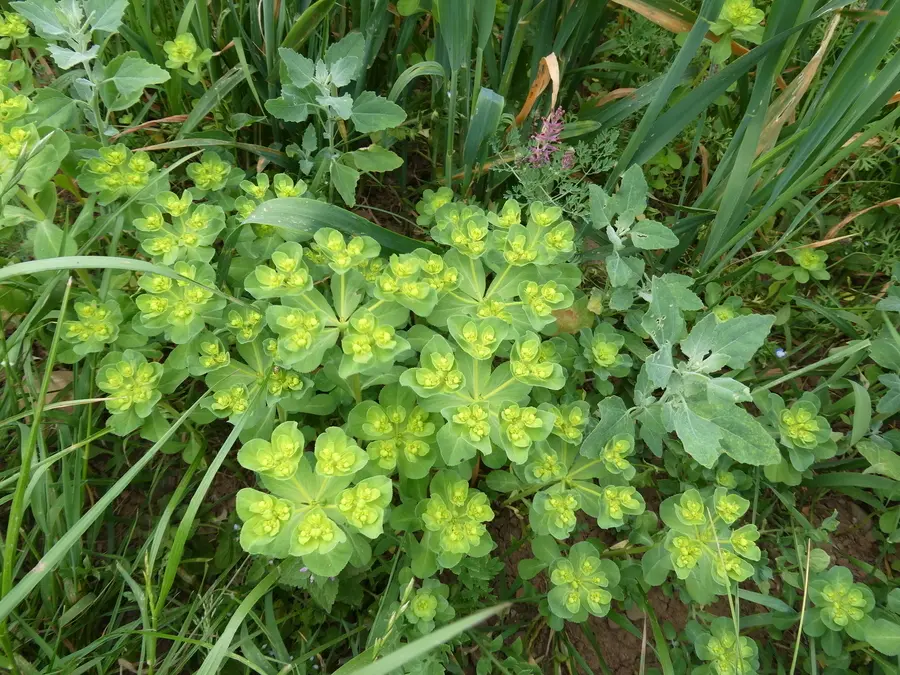 – Leominster – The heat wave has well and truly gone now. The sky is covered in grey clouds and cool southwesterly wind blows. Along Hereford Road and on to the footpath that leads to Cockcroft Lane. Half of the large field running the hillside beside the path is covered in fine mesh fabric. A cereal crop is on the other field between the path and the primary school. Sun Spurge and Fumitory flower beside the path. A Carrion Crow stands at the top of a Silver Birch behind the school.
 Onto Cockcroft Lane. Skylarks sing overhead. A Red Kite drifts across the ridge. Broad beans grow in the big field to the west of the lane hedgerow. Yellow rogue oil-seed rape flowers are dotted throughout the beans. The view towards the Black Mountains is fairly clear and very green. However, that towards the Radnor Forest looks like rain is falling. A few pure white Field Roses flower in the hedgerow. Little pink Field Bindweed peep out of the grasses.
 morning.
 wire. A Blackbird sings loudly. Past the old school. A Blue Tit is in the trees seemingly manic as it dashes to and fro through the branches seeking insects. Over Priory Bridge. The water level in the River Kenwater has risen slightly following
  the rain in the last few days. There must have been rather more water earlier in the week as the large branch that was in the middle of the stream last week has now gone. On to Ridgemore Bridge. The water level in the River Lugg remains low. A Chiffchaff is in a Field Maple overhanging the river. The tree has numerous winged fruits. Over the road, a red-flowered Horse Chestnut has small furry Conkers. A Chaffinch sings loudly. A Cormorant flies south, high over the A49.
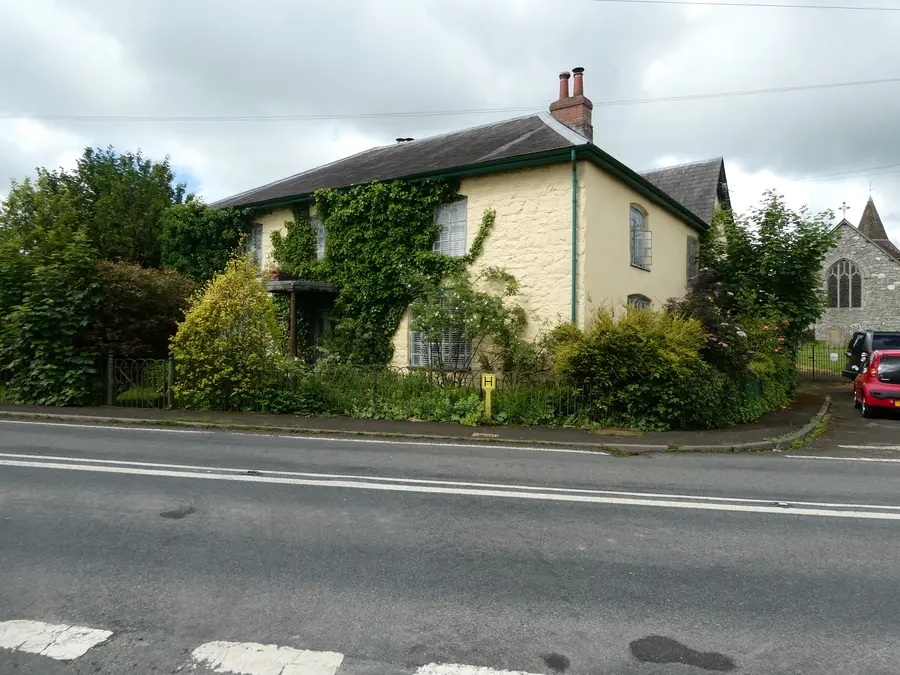 it became the Burton Arms pub named after Edward Burton of Shrewsbury. It was a coaching inn and a stopping place for sulphur springs which are across the fields towards Mithil Brook. Beside it is the church of St Tecla of Iconium.
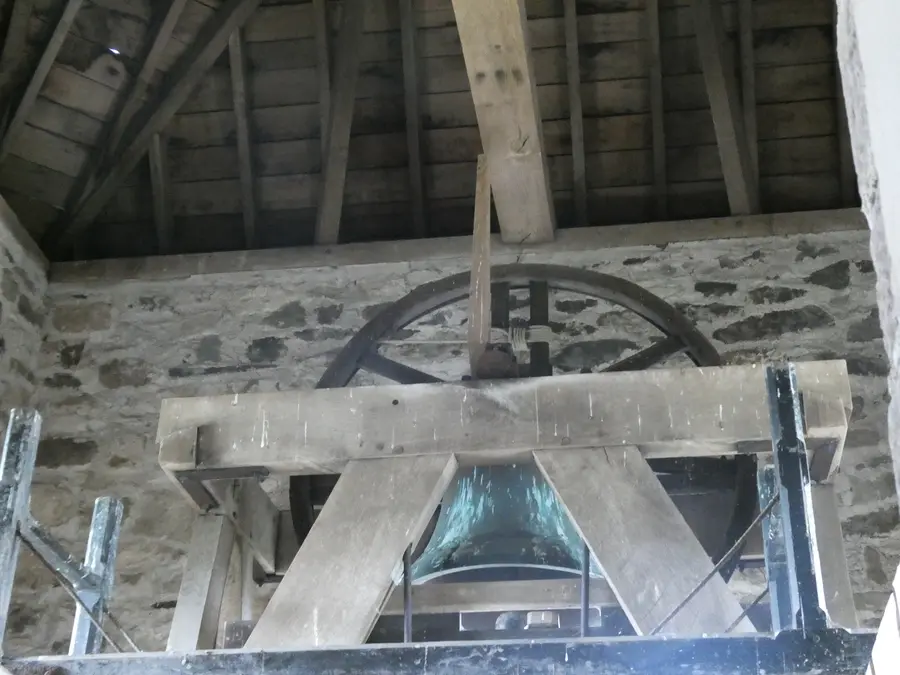 school were built. The entrance to the porch looks rather like the entrance to a barn. The tower was rebuilt in 1953. It has a single bell dated 1630. A single manual pipe organ stands in the chancel. The font is a typical Norman tub type. A chest with two carved panels is beside the organ. The east window is dated 1897 by Jones and Willis of Birmingham and London. One side window in the chancel is dedicated to Major General Robert Children Whitehead by his widow. As an Ensign in the 97th Regiment Whitehead served through the Crimean War, and was at the storming of the Redan in 1855. He was then mentioned in despatches, and received the Crimean Medal with clasps for Sebastopol, also the Turkish Medal and the fifth class of the Medjidie. He commanded the 58th Regiment through the Zulu campaign after the disaster at Isandhlwana, and was present at the Battle of Ulundi. Colonel Whitehead was again mentioned in despatches, and has been rewarded with the Companionship of the Bath. In 1908, he was appointed the High Sheriff of Radnorshire. The other is dedicated to Emily Augusta Severn, who was known as a philanthropist, by Sarah Ann Whitehead. They are both early 20th century and also by Jones and Willis. Stairs lead to what seems to be a modern or well restored minstrel gallery with a door in it leading to the tower which is splattered with droppings. The last resident vicar left in 1949.
 no sign of any inscriptions.
 stand behind the roadside hedges. A Rabbit scurries into a broad bean crop. Sunnybank farmhouse is 20th century. A bumblebee visits Field Roses in the hedge row. A Blackcap makes a stuttering call. A 17th century timber-framed cottage, Hollywall Croft, is a holiday let. Risbury Bridge crosses Humber Brook. Opposite is a very large pond and beyond Risbury Mill, a 17th century house, with later alterations, on an earlier site. The mill, with most of its equipment still intact, is beside the house. White geese graze on the grass. Another track leads to Risbury Court and hop kilns. Behind the buildings are the bramble covered ramparts of Risbury Iron Age hillfort.
 Wednesday – Leominster – Rain fell overnight and continued into the morning. It now seems to have almost ceased. The lack of wind means there is a muggy feel to the air. Down to the White Lion. The bridge over the railway to the River Lugg is still closed. A Chaffinch and Wren sing across the railway. House Sparrows feed on the footpath. A Class 67 diesel pushes a south-bound train into the station. Small green blackberries cover the Brambles, it looks like there will be a bumper crop.
 pink, others pure white, is being visited by a Small Tortoiseshell butterfly. A Skylark sings overhead. To the west the horizon is filled by the Malvern Hills. A herd of cattle in the field alongside the motorway gallop past then gather near the church to see what I am doing! Just before the church gate is a patch of Black Horehound, also known as Stinking Roger, in a larger patch of Stinging Nettles.
 priory, but there seems to be no modern record. It is likely this refers to Priory Court and the village being closely associated with Worcester Priory. To the north of the churchyard is the site of the mediaeval village and possibly the manor house of Urse D’Abetot. I head back to the beginning of the track. A pair of Marbled White butterflies fly past.
 sold in 1842 to finance the emigration of the new Latter-day Saints to the United States. It was then used as a barn and eventually fell into disrepair. A local group of Latter Day Saints purchased property in 1994 and restored it. Access is behind a locked door, the code of which is answered by 6 questions referencing the Mormons.
 the leaves and apples from the Gladstone apple tree from blocking it.
 the large stone walls of the aqueduct. A wooden
  boardwalk carries the path over marshy ground, with many bright yellow Common Monkey Flowers and Greater Spearwort and rich purple Marsh Orchids, to the Manchester Ship Canal. The Swing Aqueduct, the first and only one in the world, rotated through 90 degrees with gates at each end which kept in 800 tonnes of water. Just downstream from the aqueduct is Barton Road Swing Bridge. Both bridges are controlled from a tall red brick tower on the island on which the aqueduct pivots.
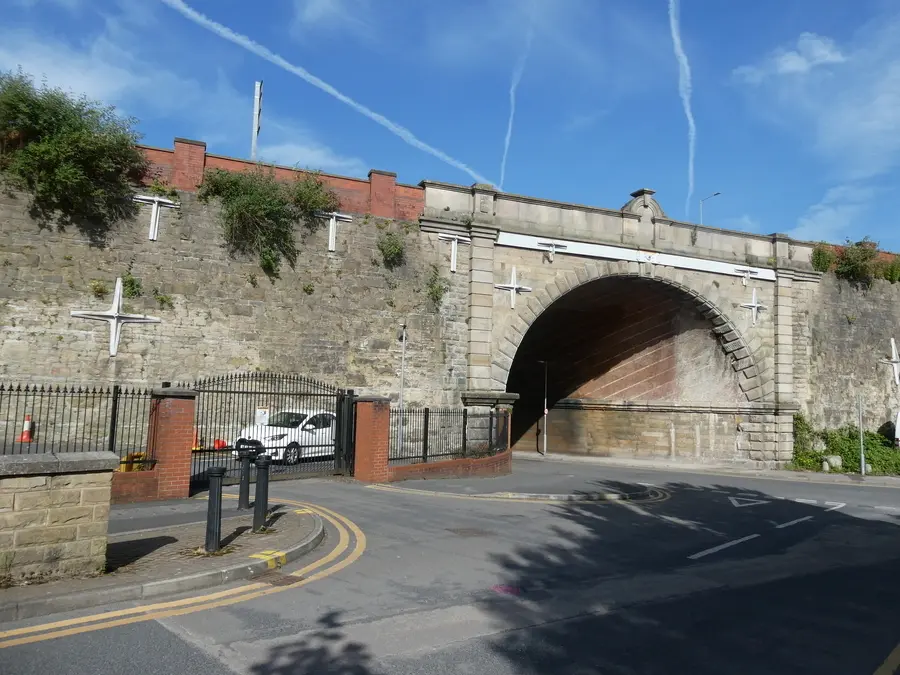 Chorley New Road at a large junction. Down a small cul-de-sac are four pillars, former gates of the Bolton Infirmary, now blocks of apartments. Chorley Street descends a gentle hill to the River Croal. It is shallow and flowing slowly. On the north side are two stone arches below the road bridge whose use is unclear. The Bolton Lads and Girls Club stand on the site of a large timber yard. White Lion Brow climbs to Spa Road.
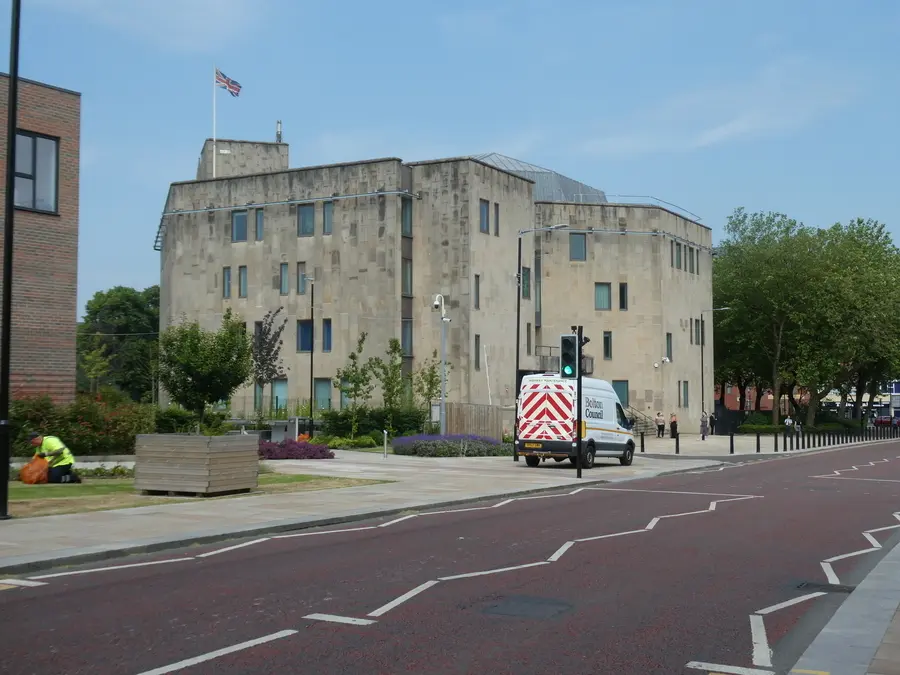 interesting. Past the Octagon,a modern theatre. Around the corner is Elizabeth Park and opposite Bolton market. The outside stalls are exclusively clothing and fabric, most aimed at the Asian market. A large box of huge watermelons is pulled out of a lift. The meat and fish stalls inside are real “nose to tail” foodstuffs, goat tripe, cow ears, sheep lungs.... And the prices are ridiculously cheap compared to home!