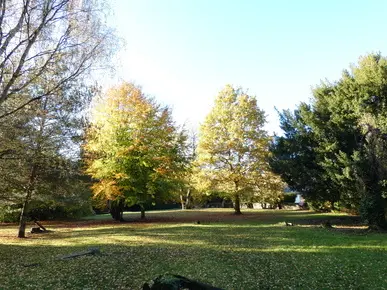
Sunday – Leominster – After a night of rain, the sky is almost completely cloudless as the remnants disappear over the eastern horizon. The sun is bright and low in the south-east. A cool, light breeze blows from the west. By Norfolk House, the pavement is covered in large yellow leaves from the Plane tree. Onto Butts Bridge. The water level in the River Lugg continues to rise slowly. A Wren sings. The Black Poplars have lost nearly all their leaves whilst Ashes and Alders still have a large amount of foliage.
Into the Millennium Orchard. Red and orange Lady’s Fingers seem to be taunting me high on the tree. Still not enough are falling to make collection worthwhile. Into the park. The trees are lit by the sun, though many are still dripping with rainwater. Robins sing. A Blue Tit searches the leafless Elders, branches green with lichen. The water level in the Kenwater has also risen. The Minster Bells toll the hour then ring out the morning prayer.
Into the churchyard where Beeches are glowing in the sun. Grey Squirrels seem to be everywhere, some digging holes, others chasing each other across the grass and up the trees.
Home – The French Climbing and Runner Beans are stripped and removed. The tall fronds of asparagus have toppled and are cut down. The remaining courgette plants are pulled, one last courgette harvested. Out come the rogue tomatoes, the spreading kind that are close to the original Mexican wild tomatoes. There are many small green fruits on them which I remove although I am not sure what I will do with them. All the foliage goes into the compost bins. Sadly, the leeks seem to have disappeared, probably pigeons. The bed has some very large rogue potato plants. I will leave them until the frost gets them and then see if there is anything underneath. A large carrot and beetroot are dug for dinner.
Wednesday – Bodenham Lake – Sunshine glares off of the road still saturated from last night’s rain. Through the village. Overhead skeins of yelping Canada Geese wiffle to lose height as they descend on the lake. Into the car park. Spindle leaves are turning deep red. Chaffinches feed by the track. Half a toadstool rises out of the grass. It takes an age to identify. It appears to be a Rose-gilled Grisette or Stubble Rosegill, Volvopluteus gloiocephalus. Its common and scientific names have changed several times which does not help and whilst there are some photographs on the Internet which look exactly like this one, the picture shown in Roger Phillips usually excellent guide looks nothing like it. Dark clouds sweeping obscuring the sun. The east end of the lake is largely empty just a winter plumage Great Crested Grebe. The sound of chain saws comes from the western end.
Onto the meadow. Westfield Wood is a glorious mêlée of gold, brass and copper. Into the hide. A large number of Canada Geese and Greylags are across the water. Six Grey Herons, a number of Mallard and several Cormorants are on the spit. Several Shovelers and possibly Teal are on the far bank, although it is hard to be certain at this distance and, as usual, I have not brought my scope. Closer, a couple of Moorhens stalk around the scrape. A Eurofighter Typhoon roars over. The chainsaws are cutting down a tree beyond the west end of the lake.
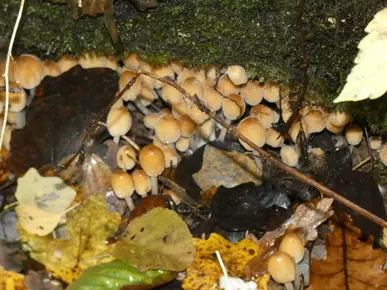
Back into the Alder plantation. Fungi have emerged on rotting logs. Large numbers are Fairy Inkcap mushrooms Coprinellus disseminatus, which are also known as Trooping Crumble Caps, Glistening Inkcap, Coprinellus micaceus, Smoky Bracket, Bjerkandera adusta and Varicoloured Bracket (or Turkeytail or Many-zoned Polypore), Trametes (or Coriolus) versicolor. Up to the meadow where there are no fungi. Mycologist Richard Fortey considers there may be two reasons for this; firstly, improved grassland is over fertilised which fungi do not like or conversely unimproved grass that is not cut grows rank and coarse which is also unsuitable for many fungi. Into the cider apple orchard. It appears that the apples have still not been collected and are beginning to rot. There is still a surprising absence of winter thrushes here. A Great Tit calls from a leafless apple tree.
Back along the Gloucester road where a large flock of corvids, mainly Rooks, are on the hillside pasture.
Home – I am still trying to persuade Rhode that she is not hatching eggs, with little success. The other two have laid this morning, so I block off the nests and leave the back hatch open. This does not seem to dissuade her much. Some of Kay’s newly planted bulbs have been removed and left on the path, presumably by Grey Squirrels. She resows them and I cut up some wire mesh and place the pieces over the soil to keep them off. It is half past four in the afternoon and getting rather dark.
Friday – Leominster – A day of changeable weather. Earlier there was a little sunshine but now it is grey and the sky looks like it is threatening rain. The water level in the River Lugg has risen again. Rubbish is being washed down now, some caught on an Ash branch dipping into the flow.
Through the Millennium orchard. The Dabinett apples are now beginning to rot but the Lady’s Fingers have still not fallen. Onto Pinsley Mead. The River Kenwater is flowing swiftly.
Home – Yesterday’s experiment at excluding Rhode from the hen house has fallen down today as only one of the other hens, Silver I think, has laid. Blue, if it is her, lays in the afternoon. I leave the back flap of the house open but will have to close it up soon as it starts to get dark.
Wednesday was the full moon, the Beaver Moon and a “supermoon”. It was, of course, hidden here by the blanket of cloud. Last night, the cloud broke up in the early hours and the huge bright moon shone down from on high.
Sunday – Leominster – Everywhere is wet but slowly drying. There is a little patch of blue sky on the east but the west is uniformly grey. The pavements are slick with saturated, decaying leaves. Over the railway to Butts Bridge. The carpet of yellow Black Poplar leaves is now muddy brown. The surface of the River Lugg is dotted with more leaves. A Carrion Crow calls, krark krark krark. Back onto the railway bridge. The sun has emerged enhancing the pink of a Wood Pigeon’s breast.
Into the Millennium orchard. I pick up half a dozen large cooking apples, probably all Bramleys. Into the churchyard. The minister’s bells ring loud and clear.
Wednesday – Leominster – Rain that started yesterday evening has finally stopped in the early afternoon. Grey clouds still cover the sky. Down to the railway bridge. Below a large rabbit bounces away into the undergrowth. Onto Butts Bridge. Unsurprisingly the River Lugg continues to rise. Trapped rubbish from earlier in the week had been swept away. Back to the White Lion. A perfect V of geese flies northwards. A small flock of gulls head south and several finches cross the railway and disappear towards the Grange. The rain returns.
Through the Millennium Park, Pinsley Mead and down The Priory to Priory Bridge. The River Kenwater is flowing swiftly and muddy. A young Mute Swan, still in its muddy brown-grey plumage, glides past.
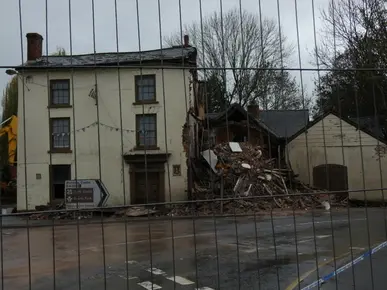
On to Mill Street and along to the junction with Bridge Street. Yesterday morning a refuse lorry, or dust cart as I still think of them, ran across the roundabout and crashed into the front of the large house that was once The Golden Lion Inn. Sadly, one of those in the cab was killed. The damage to the building is extensive and demolition machinery is already on site. It will be a sad loss, the building was early 19th century and a good example of a Georgian hostelry.
Saturday – Home – Storm Claudia, named by the Spanish Weather Service, passes through very slowly resulting in rain falling continuously for over 24 hours before finally stopping before dawn. Unsurprisingly everywhere is saturated. The sky is still a uniform pale grey and there is a cool easterly breeze. Grey Squirrels, Jackdaws and Wood Pigeons scatter as I head to the chicken house. Rhode is off the nest and the other two have laid so I block access to the house for the rest of the day in an attempt to disrupt her broodiness.
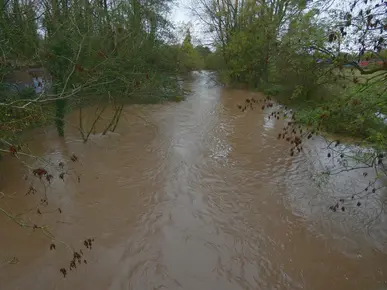
River Lugg 7th November 2025River Lugg 15th November 2025
Leominster – Pavements are slippery with wet leaves. On to the railway bridge. The platform information board shows all trains have been cancelled. On to Butts Bridge. The River Lugg has risen over two metres since yesterday morning. The path at the foot of the steps onto Easters Meadow is under water. The water is reddish brown, carrying tons of soil.
Into Pinsley Mill. Four Blackbirds are in a Hawthorn bush across the railway. Blue Tits are moving through the bushes. Ladies Fingers cider apples are finally beginning to fall in the orchard. A Song Thrush sings in the churchyard. On to the Peace Garden. The River Kenwater rushes past, almost to the top of the bank. A Robin sings its winter song, more of a brief whisper than the full blooded summer song.
Tuesday – Leominster – The air flow has swung around to the north and the temperature has dropped 10° since the weekend. Dark clouds move across the sky but in a clear spot Jupiter shines brightly. A faint point of light passes it rapidly, probably Cosmos 1356 rocket body, launched on 5th May 1982 from Plesetsk, Russia.
Home – It seems certain now that Rhode’s broodiness has passed. Water in the bird bath has ice on its surface. Ivy on the back wall is looming over the path again, so the stems are cut on this side and I will remove the top growth at the weekend.
Wednesday – Leominster – A cold wet start to the day although the hills are covered in snow. A cold north wind blows pushing large cumulus clouds across the sky. Down to the railway bridge. A good deal of Travellers Joy, our Wild Clematis, grows by the fence which runs alongside the old track. Looking at it directly the fluffy flower heads appear grey, but when the sun shines through them they shine silver. The water level in the river has fallen six feet in the last couple of days. A Mistle Thrush rasps in the Black Poplars.
Back through the orchard. An apple tree is surrounded by fallen yellow fruit. It is a Pitmaston Pineapple, also called Radcliffes NonPareil. It is believed to be a seedling of Golden Pippin recorded in 1785 but introduced by John Williams 1773-1853, a Worcester businessman. They are delicious! The River Kenwater has also fallen about three feet.
Friday – Leominster – A cold frosty morning, temperature below zero, is followed by a bright sunny day. Down to the River Lugg where the water level continues to fall. The trees and river are empty of bird life. Back over the railway bridge. At the foot of the bridge the telegraph pole surrounded by an Oak, a Holly, an Ash, a Yew and a Hazel. I wonder which will come to dominate in years to come, or maybe they will all be chopped!
Into the Millennium Park. A few more Pitmaston Pineapple apples are gathered. Blackbirds are giving out alarm calls. A Common Buzzard takes off over the trees. Blue and Great Tits fly from bush to bush. Into the churchyard. A line of molehills runs around the edge of the bare patch made by a Yew. The Athens to New York Airbus leaves rapidly dissipating vapour trail. A Grey Squirrel runs up a tree with a Beech nut in its mouth which it then drops.
Onto The Grange. A Mistle Thrush calls. A Magpie picks up crumbs around a bench.
Sunday 23rd November – Leominster – A largely blue sky with scattered high cloud. Everywhere is wet. Jackdaws fly around the rooftops. A New York to Delhi Dreamliner flies over leaving a short vapour trail, then a 737, Manchester to Marrakech. Onto Butts Bridge. The water level in the River Lugg is unchanged. A Blue Tit chatters and a Mistle Thrush rasps. Very few leaves remain on the trees now.
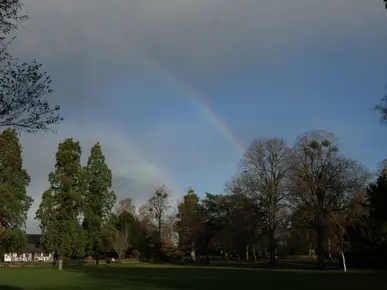
Through Pinsley Mill. A Lesser Black-backed Gull flies high above in large circles then flying in off one direction, returning, then another direction, seemingly indecisive about where it is heading. Into the churchyard. A Robin sings more vigorously than the usual autumn song. Grey Squirrels chase each other through the trees. A Magpie churrs and a Great Spotted Woodpecker chips. A croaking Raven flies over. Dark clouds are thickening in the north west. A rainbow arcs briefly across the Northern sky. A tree surgeon is up one of the pines that stand between The Grange and the car park cutting off a dead branch.
Tuesday – Home – Yesterday a fair sized flock of Redwings flew over, the first I have seen around here, although they have been reported across the county for some weeks now. This afternoon it is sunny but cold. The bed in the greenhouse is cleared, a few green tomatoes and a couple of chillies harvested and the plants off to the compost bin. New compost is dug and a couple of troughs filled into which go some very small lettuce and Chinese leaves seedlings. Hopefully, they will take and give an early crop next spring. Two troughs of basil are composted, just a few leaves remained, enough for tonight’s tomato sauce. A Robin joins me in the greenhouse looking for anything turned up. Some volunteer potatoes had grown quite large then been destroyed by the frost. I dig them out and gather a handful of tiny new potatoes. Hens Silver and Blue are laying decent sized eggs now, two days out of three. Rhode has yet to start laying after ending her broodiness.
As evening draws on, around twenty Jackdaws gather in the Ash tree. They then all depart. A crescent moon hangs in the southern sky.
Wednesday – Leominster – In the night the alarm call of a Tawny Owl is repeated for a short time. At dawn, there is a heavy frost. Pink cirrus clouds are scattered across the sky.
The day becomes milder, though still cold, under a grey sky. Onto the railway bridge a Song Thrush sings intermittently. A Magpie flies out of the riverside trees and over Pinsley Mill to the churchyard. The Milford Haven/Aberdaugleddau train pulls into the station. Onto Butts Bridge. The water level in the River Lugg looks unchanged.
Into Pinsley Mill. A lone Redwing is feeding on haws. A Common Buzzard is high in a Black Poplar by the river, sitting above large balls of mistletoe. In the Millennium orchard Jackdaws are picking at the Lady’s Fingers apples that are yet to fall. Some more Pitmaston Pineapple apples are gathered. I tell a passing woman what they are and she takes one to try. A Rabbit is by the broken tree at the foot at the churchyard.
Into the churchyard. Many more molehills have been thrown up. A Pied Wagtail stands on one.
Sunday – Leominster – A scattering of nimbus clouds are in the sky. The thin ones pink and the thicker ones Grey. There has been a light frost. The water level in the River Lugg has risen again by around three feet.
Into Pinsley Mill. Two Cormorants fly upstream above the river. A Common Buzzard is in the same Black Poplar as a few days ago. A pair of Chaffinches fly over. Half a dozen Blackbirds are feeding on haws in the track side bushes. Into the Millennium Park. Four Magpies are squabbling at the far end. Two rabbits bounce along beside the nettles at the foot of the churchyard. The Magpies fly up into the trees chattering noisily. The River Kenwater is flowing rapidly.
Into a churchyard. A Grey Wagtail is on a chest tomb. A Mistle Thrush rasps high in the trees. Onto the Grange. A Raven is croaking from the top of one of the Wellingtonias beside the old cricket pavilion. Bell practice commences.
Home – We sweep up five large bags of wet leaves for leaf mould. The lettuce and Chinese leaves planted into troughs in the greenhouse look to have taken well.
 breeze blows from the west. By Norfolk House, the pavement is covered in large yellow leaves from the Plane tree. Onto Butts Bridge. The water level in the River Lugg continues to rise slowly. A Wren sings. The Black Poplars have lost nearly all their leaves whilst Ashes and Alders still have a large amount of foliage.
 the scrape. A Eurofighter Typhoon roars over. The chainsaws are cutting down a tree beyond the west end of the lake.
 away into the undergrowth. Onto Butts Bridge. Unsurprisingly the River Lugg continues to rise. Trapped rubbish from earlier in the week had been swept away. Back to the White Lion. A perfect V of geese flies northwards. A small flock of gulls head south and several finches cross the railway and disappear towards the Grange. The rain returns.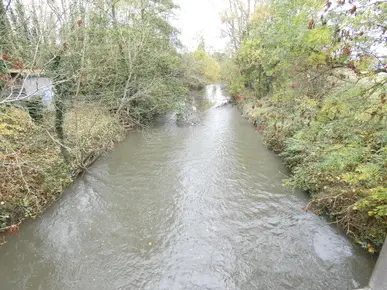
 water level in the River Lugg is unchanged. A Blue Tit chatters and a Mistle Thrush rasps. Very few leaves remain on the trees now.