Tuesday – Vale of Neath – I stop at Rheola Lodge, an abandoned lodge house. To the north are abandoned barns and farmhouse. Beyond is the Rheola Estate behind the Ron and Marion Rees Memorial Gates. The Rheola Estate was a large house built in 1812-14 by John Nash for his cousin John Edwards. It was gutted by arson a few weeks ago. Nearby are two pillars with broken lamps and a large modern gate to the former Rheola Aluminium works, operating from 1939-1981. The house became the administrative offices of the works.
Conifer covered hills rise to the west. Across the Glyn Neath Road is the Neath Canal. A track of large cobbles leads to a cast iron canal bridge. A Grey Wagtail flies off. To the north is Rheola Aqueduct, a small aqueduct just a few feet high, carrying the canal over Rheola Brook which flows from the Rheola Pond to the Afon Nedd/River Neath which flows a short distance away. The sound of traffic on the A465 is ever present.
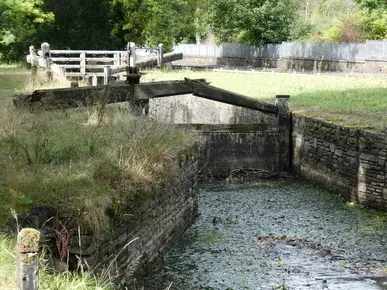
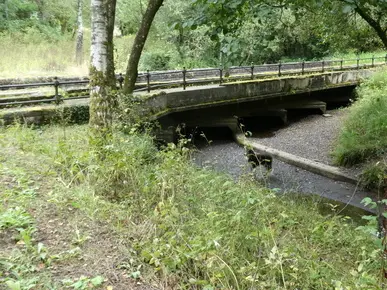
Onto the tow-path. A Jay calls. Oaks line the tow-path, they show signs of coppicing many years ago. Past a traditional stone bridge. The canal is now completely choked with rushes. The canal turns into a muddy ditch before reaching the ruined, rotting Rheola Isaf lock. The overflow channel is beautifully built with a stone circular tunnel taking the water from the top to the bottom of the lock. Marshy land on the other side of the tow-path is congested with Bracken, Rosebay Willowherb, Himalayan Balsam and a very large patch of Japanese Knotweed. Crugiau lock is also rotting away. Crugiau Bridge is slowly disappearing under Ivy. A large concrete structure is all that is left of a railway bridge that took a line into the aluminium works.
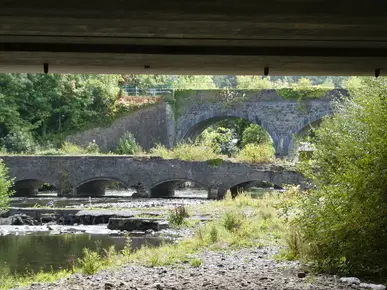
Aberdulais – We have been here before to visit the tin plate works. After a short but heavy downpour, I head down to a modern bridge over the Afon Dulais. A Dipper is on the rocks below. A path runs down from the road and under the larger road bridge carrying the A465. The River Dulais is turned by an old weir and then enters the Afon Nedd. Grey Wagtails bob up and down the weir. An aqueduct carries the canal across the Afon Nedd. On the other side is a railway viaduct built in 1852 by Brunel for the Vale of Neath Railway. The line closed for passengers in 1964 and to mineral freight shortly after. A road bridge takes Station Road across the canal. A lock is to the north of the bridge; it is in a ruinous state. A wide overflow channel runs around a small patch of land. Beside the lock is the former lock keeper’s house, now the Royal British Legion. Under the bridge is an old canal barge, Brinklow. Canal Side, Ochre Y Gamlas, is a row of houses and a Wesleyan Methodist chapel of 1901, now a residence. A Moorhen squeaks on the canal. Opposite is a modern canal shed with what look like new mooring posts outside.
Back to the main road. Dulais Rock hotel is closed and vanishing under vegetation.
Tonna – A village on the opposite hillside to Aberdulais. The name comes from the old Welsh word tonnau, meaning grassland or a lea. It developed as a mining community. The church of St Anne was built in 1891-2 by E H Lingen Barker, architect of Hereford, at the expense of the Revd David Griffiths. The church is a Gothic cruciform structure of native stone, with Bath-stone dressings.
Neath/Castell-Nedd - The road from Tonna is continuously lined with houses into Neath. My hotel, The Castle, is a very large building in the town centre. It was known as the Ship and Castle Inn in 1745 and hosted social occasions patronised by the gentry, a freemasons’ lodge and administrative and judicial meetings. It was also a coaching inn on the “Milford Road”, catering for intermittent coach services between Swansea and Merthyr. The Welsh Rugby Union was formed here in March 1881. Nearby is the Old Town Hall. On the opposite corner is The Angel pub of 1905, now Castell-Nedd Arms. Back along The Parade. Victoria Chambers is a cocktail bar. A large former bank seems to be empty. Behind these buildings is the old market, still in operation. It was built in 1837, enlarged in 1877 and remodelled in 1904. The road dog-legs cutting through what was the cattle market. Modern buildings have replaced those around the old market. Between the main street and the railway is the Maed-yr-Haf, an independent chapel, built in 1769 and rebuilt in 1864. Back on the main street, now Windsor Road is a gently curved former bank built in 1924 as the National Provincial Bank by F C R Palmer and W F C Holden in the Free Classicism style. A short distance away are two more banks, both operating as such, built in the early 20th century. Neath station is modern as is the closed Post Office. Next to it is the old Post Office of 1927. The County Police Station of 1937 is a pub. The road continues with down-market shops in three storey, late Victorian, early 20th century buildings. A passage, constructed by Brunel in 1850, passes under the railway into Commercial Street. A building is listed for having traditional grocer’s fittings but it is completely boarded up. Back up to The Parade.
Into Green Street. A four storey building of 1897 has an ornate façade. Next to it is an early 19th century commercial building. A large undated building in red brick with cream features has a lead cupola. Into Orchard Street. Gwyn Hall is a building of 1887-1889 by John Norton of London costing £6,000 on a site donated by Howel Gwyn, who served as alderman, town councillor, mayor, Freeman of the Borough, chairman to the board of Guardians, High Sheriff of Glamorgan and MP for Brecon and Falmouth. The building now has a large glass frontage. Opposite is the Constitutional Club opened on 19th August 1886 by Stafford Henry Northcote, 1st Earl of Iddesleigh on land donated by Howel Gwyn. It is a very ornate Gothic style. Next to it is the church of St David, like all churches here, locked. It was built in the French 13th century Gothic style, consecrated on 29th November 1866 and designed by John Norton. A carved tympanum is of St David. Across the road is Victoria Gardens of 1897. A band stand is believed to date from 1898, but the foundry name is illegible. A bronze statue of Howel Gwyn stands near the entrance. Opposite is the English Baptist church, built in 1839 and altered or probably rebuilt in 1879.
Wednesday – Neath/Castell-Nedd – Fine rain falls. Along Croft Road where some of the buildings are 19th century and older. Into Bridge Street. Many were commercial warehouses. The Zoar chapel, built in 1828 following a church division, closing in December 1965, is behind a garden centre. A bridge crossed the Neath Canal which is rush filled with the requisite supermarket trolley and traffic cones. One of the Spearworts growing in the water has yellow flowers. Opposite is the Moose Hall, a happy-clappy church and the Neath Athletic Rugby Football club. A footbridge crosses the Afon Nedd which is tidal here, the Tennant Canal, the very busy A465, the railway line and Neath Abbey Road before descending to the local college. To the south of the college stood a Roman fort, Nidvm. An Auxiliary fort first built in around 74CE from earth banks and wooden structures. It may have been garrisoned by perhaps 500 auxiliary troops and was abandoned in around 125CE, but re-occupied around 140CE when it was rebuilt in stone. The railway lines is the Swansea-Neath Low Level which closed in 1964 for passengers but was used for minerals until 2022. Below is a red signal still lit and up the track is the signal box. Beneath the bridge is an older river bridge erected in 1790s to replace an earlier bridge at this historic river crossing. A timber bridge was recorded near here by John Leland in the 16th century, a later bridge being of timber and stone. The bridge was designed by David Edwards, son of the famous bridge builder Revd William Edwards of Pontypridd. A few Mallard are on the river. A Little Egret flies downstream and lands on the muddy bank. Upstream is a rather rusty railway bridge carrying the London-Swansea line and a bridge carrying the B4434.
Porthcawl – Along a very wet M4 and down to the sea at Porthcawl. The weather is supposed to be showers but this looks like set-in rain. The main road into the town, the A4106, is on the line of the GWR Porthcawl Branch railway. From the Eastern Promenade a road passes the marina, opened as recently as 2014, replacing the outer basin of the docks. The docks were north of here in an area now filled in and used as a car park. The development of the dock was undertaken by the Brogden family who had purchased the Tondu Ironworks from Robert Price in 1853 and were developing coal mining in Ogmore Vale, the products being transported from the Valleys by the Dyffryn Llynfi and Porthcawl Railway for export from the small harbour built for that purpose at Porthcawl. Jennings warehouse is spoiled by a modern extension all along one side. It was built 1832 by James Allen, the proprietor of a spelter works at Dyffryn, as the southern terminus of the Dyffryn-Llynfi-Porthcawl horsedrawn tramroad. Name dates from 1911 when it was used by Jennings & Co, timber importers. The old customs house is a small sandstone building constructed in 1867. The lifeboat station and coastguard lookout stand at the beginning of the harbour arm. The lookout tower is believed to have been first placed here in the 1830s and this building was firs constructed in 1867. At the end of the breakwater is the lighthouse built 1866 by Messrs Stephen of Bristol. It is a tapered hexagonal cast-iron tower, painted black and white on a stone plinth. The lantern was replaced following destruction in storm of 1911. Visibility at sea is reduced by the rain. The sea is moderately rough. Two speeding zodiacs bounce violently on the waves.
The Grand Parade is mainly late Victorian with modern additions. This and other parts of the town were developed by James and Mary Brogden. The Grand Pavilion is behind hoardings. It was built 1931-2 by E J E Moore with L G Mouchel as consultant engineers for the concrete dome, an important example of ferrous-concrete (Ferrocrete) work. It was sponsored by Russell Mabley, elected Porthcawl’s chief citizen. The sea wall was built by Brogden but by the 1980s was being undermined. A asphalt revetment was built to dissipate the wave’s energy. These had to be replaced in by a series of revetments in 2019. Rocks are exposed at either end of the bay. A couple of Turnstones are on them. The Seabank Hotel is a grand hotel just beyond the pavilion. The first hotel was built in 1860 by George Dement as a smaller building named the New House. A larger house was built in 1870 and obtained by John Brogden. It became Porthcawl College in 1891 which was run by Revd E J Newell of Oxford University until 1906. In 1907 creditors of the Brogden family, the owners of the building, called in their loans and it was bought by John Elias and others for conversion into a hotel. The Sea Bank Hotel opened in 1910. It was reconfigured in the 1930s. In 1943, US troops of the 28th Infantry Division were stationed at the hotel, followed by the 75th Infantry Division in 1944 to train before the Battle of the Bulge. In 1945 the hotel underwent major refurbishment and again in the 1990s. Rounded frontages to give maximum sea views and a tower resembling a lighthouse. A relatively modern seating shelter has an old drinking fountain set into the stonework.
I am now absolutely saturated, the rain has not stopped, so I retreat to the car. On the way I visit the public convenience and for the first time ever have to use a debit card to get in.
Friday – Home – A Tawny Owl is hooting nearby at around midnight. A couple of hours later there is a heavy downpour of rain, which eases by continues until dawn. The day is grey and damp. The courgettes have slowed down but are still appearing. In the greenhouse, basil is beginning to flower but pinching out will hopefully provide a last good picking. Cabbage, mustard and lettuce seedlings are progressing slowly. Kay has cut down the Golden Rod which has suffered in the downpours. We can now get to the compost bins with out getting wet!
Sunday – Leominster – A lot of the sky is covered with cloud. Rain fell shortly before dawn and it is wet everywhere. I decide to give the market a miss as this sort of weather will probably reduce the number of vendors attending. A Wood Pigeon flies out of the great London Plane tree scattering drops of water over the road. The footbridge over the railway carrying the Herefordshire Way national footpath is still closed. Network Rail seem to have exceeded their permitted period on their licence but it is unlikely any authority will do anything about it.
Into Pinsley Mill. Broken hazelnuts are scattered across the pathway. A Magpie churrs, Blue Tits squeak and there is the occasional faltering song of a Robin. Into the Millennium orchard. A large number of Tom Putt apples have fallen. I need to make a decision as to whether or not I am going to make cider this year. A Chiffchaff calls in the park. Elderberries hang in thick bunches being eaten by Wood Pigeons. Spindle trees have a good crop of matt cerise berries. The River Kenwater is flowing steadily although the water level has barely changed. The clouds are thickening.
Into the churchyard. A slight breeze sends down showers of rain from the trees. Sunlight shines off of the leaves and the tower of the Minster. Rabbits, one assumes, have dug numerous shallow holes in the ground making it important keep one’s eyes open as a twisting an ankle could be very easy. Grey Squirrels scurry across the grass. A pair of Mistle Thrushes and a Nuthatch fly up into a tall conifer. Carrion Crows start cawing loudly then fall silent.
Wednesday – Home – The Tawny Owl is hooting around midnight. I am then awakened in the early hours by a very loud hoo-hoo, the owl is back and very close to our bedroom window. This wakes up some Jackdaws who complain before falling silent until dawn.
Another sack of Brambles are removed from the end of the garden. Heavy pruning is going to be required here during the winter. The Hazel needs coppicing again, an Elder needs to come out completely and an ornamental tree has a lot of dead branches which need removing. The Conference pear is leaning badly again and I think the branches on the path side will have to come off.
A few more Doyenne du Comice pears are harvested. There are still more getting riper. Courgettes are still being produced. Half a dozen cabbage seedlings are pricked out, but they do not look particularly vigorous. The cucumber plants in the greenhouse are removed along with a couple of the tomato plants that are finished. The Callaloo are slowly being removed and mainly fed to the hens. The Dwarf French Beans has cleared. Winter Rye is broadcast across what was the potato bed this year.
Leominster – Although the sky is partially covered in clouds, the sun is shining through and it is warm. We now understand the footbridge to the River Lugg will not be open again until November at least. Into Pinsley Mill. Hawthorns are still carrying a good crop of scarlet haws, the winter thrushes have yet to arrive. Rosebay Willowherb flowers are finished and the fluffy white seeds are looking bedraggled. Large White butterflies are active.
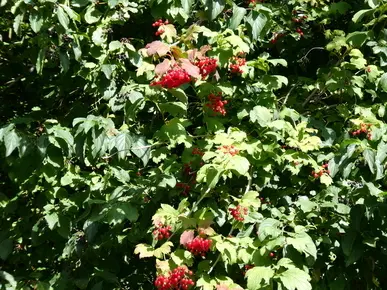
A Manchester bound train passes pushed by 67020, a diesel locomotive built by Alstom in Valencia, Spain twenty years ago. More cider apples have fallen. A few Pitmaston Pineapple apples have fallen but they are hard and not fully ripe. The crop will be small this year. However, the hedgerow has a fine crop of shiny red Guelder Rose and Hawthorn, powdery blue-black Sloes and gleaming black Dogwood berries. A very few Ragwort and Black Knapweeds are still in flower but most others are now in seed. Now the southbound train passes, hidden by the hedges. Cyclamen are in flower in the Peace Garden. A Kingfisher arrows its way up the River Kenwater. The water remains shallow and clear.
Sunday – Leominster – Heavy rain fell in the night and the morning is humid and wet. Jackdaws chack from the roof tops. Robins sing. I gather a few apples from the tree at the beginning of the ginnel to the closed footbridge.
There was to be an orchard clear-up yesterday but I cannot see any difference. It had been decided that strimmers are not to be used, scythes only. I cannot use a scythe as it is all hip movement, so there is little point in me getting involved.
The Millennium Park is a gloomy mess. Stinging Nettles are encroaching from all sides. The beds of Cranesbills and Knapweeds should have been mowed. The railway hedge is growing out onto the green. A Great Spotted Woodpecker calls. It starts to rain. Giant Puff Ball fungi are emerging near the entrance to the churchyard. Recent rain seems to have had little effect on the water level in the River Kenwater.
Home – I start to press the Tom Putt cider apples I collected yesterday. A Chiffchaff calls. It seems to have been a good breeding year for Blue Tits as there are half a dozen or more on the feeders. House Sparrows are also dropping in regularly. Grey Squirrels are moving through the trees, young ones I assume as they seem quite small. They are leaving chewed conkers around the lawn. I finish with three gallons of juice today but there are over three sacks to be processed tomorrow.
Wednesday – Bodenham Lake – A cool cloudy morning with small patches of blue showing. V-shaped skeins of cackling Canada Geese fly over the village, well over 100. A Raven and a Jay fly over. Along the track from the car park. Small numbers of flowers are still showing – Common Toadflax, a stalk of Yellow Rocket, a patch of Red Bartsia, St John’s Wort and a single Evening Primrose. There is however a profusion of red berries – Guelder Rose, Haws and Rose Hips. Around the islands in the Sailing Bay are Mallard, a few Tufted Duck, Greylags, a large number of Canada Geese and a couple of Little Egrets. Around the corner, on the meadow bay, are many more Canada Geese and a few Coot.
Along the meadow. Robins sing from various directions. Into the hide. The water in front is empty of birdlife. A Little Egret is on the spit and a Great White Egret flies across and out of view. At least 18 Cormorants are in the trees. Numerous Canada Geese are on the southern side. A Common Sandpiper walks the edge of the scrape. A Moorhen splashes in.
Back onto the plantation. Fallen, rotting tree trunks are usually hosting large growths of fungi at this time of year, but there is no sign of it this year. Back through the orchards where apples are falling widely. I collect a few dessert apples. A Common Buzzard circles overhead.
Home – Just before dawn a female Tawny Owl screeches then tuits close to the garden. Yesterday we cleared the rampant rambling rose along the west-side wall. Today Kay does an heroic job chopping the long stems and clearing the area. I need to think how I am going to deal with the large patches of Callaloo, they will already have dropped seed and will be back next year with a vengeance.
Friday – Weobley – It has been some years since my last visit to the Herefordshire village to the west of Leominster. The sky is overcast and the morning is the coolest this autumn. The Domesday Book spelled the name Wibelai and was held by a Saxon nobleman named Eadwig Cild before the Norman Conquest. After the Conquest, it was granted to Roger de Lacy. The Domesday Book mentions a priest, evidence that a late Saxon church stood here at the time. The small building by the car park is slowly deteriorating under Ivy. It was formerly the water pumping station and is still owned by Dŵr Cymru. Across Meadow Street is the Manor House, a 16th century hall with gabled wings. Around the corner is the old Vicarage, a mid 15th century axial hall with the service and solar bays under one roof. Two gables were added a century later. Next to the hall is a 17th century four bay threshing barn used as the tithe barn. Beyond heading out of the older part of the village, are more 17th century houses.
Along Back Lane. Bell House is 17th century. This and the lane by the car park, Bell Square, suggest there was a bell foundry in the vicinity. Past large 20th century houses. A Grey Squirrel bounces across the road. Towards the village centre the houses grow older. The local history centre, museum and library are in the former school. Marlbrook House has jettied a cross-wing with timbers dated to 1441. The main hall has wood from 1494. This was formerly a butchers with a 16th century barn behind, formerly the abattoir whose upper floors have open wattle to provide ventilation. On a junction is the old forge dating from the 16th century. Across the road, in Chamber Walk or Mill Bank, is the mid 19th century former corn mill, now residences. The mill was built with four storeys with a fifth added some years later. A ground floor dwelling has done wonderful wooden models in the window. Beyond the mill buildings is an iron water pump. Along the road is the Hall of Remembrance. It was the Territorial Army Hall. Renamed the Hall of Remembrance and donated to the village by Colonel Leather in memory of his wife after her death in 1928. It was the community centre until 1991. Next to it is Chamberwell Cottage, a “Vote House” where MPs were elected by the small number of voters. The name is believed to refer to a chamber which stored potable water from an unpolluted well. The Marlbrook which ran through the village was polluted by a number of industries. The lane leads out of the village.
Back to High Street. The Salutation Inn. Portland and Broad Streets contain the village shops, a number of which have closed in recent years. A garden runs down the centre between these streets. The market hall did here until demolished in the 1860s along with 70 houses by the Lord of the Manor, the Marquis of Bath. Others were destroyed in a fire in 1943. Still in the High Street is the entrance to the castle grounds. A medieval hall was once a butchers. Unicorn House an example of a Herefordshire half-Wealden house constructed around the mid 15th century. Next to it is the Unicorn Inn. Opposite is an early 18th century house, empty and in poor condition.
Into Hereford Road. A large house was originally called the Unicorn and then The Throne. A former inn, the wing is dated from the mid 17th century whilst the main range is 18th century. It is said King Charles I slept here on 5th September 1645 after his army had relieved Hereford. The old Grammar School was built around 1660 possibly in part by John Abel with a bequest from William Crowley. Castle House is a Georgian villa, home to Colonel Leather and Ella Mary Leather, the folklorist in the early 20th century. Ella Mary Leather worked on collecting local folk songs with Ralph Vaughn Williams and Cecil Sharp. Her seminal work, Folklore of Herefordshire published in 1912. In 1913, Leather began working as the Commandant of the Red Cross volunteers stationed at Sarnesfield Court Hospital. For the duration of the war, she invested her time to war activities. Her son, John Francis, died in France in 1918. She died in 1928 aged 54. A water pump stands next to Spring Cottage.
Back to Broad Street. Tudor Cottage is dated by a plaque as 1530, but is probably is 80 years older. It had a Victorian brick facade covers two half-Wealden houses. Across the road, two houses was the Bear Inn. Weobley was a substantial town in the 13th century but by 1628 was Rotten Borough, a small borough with an informal patron, the Marquis of Bath. It had two MPs until the Reform Act of 1832. Voters traditionally came to The Bear on election night and the results were announced from the balcony. The next building is The Gables, one off the largest 15th century halls in the village. At the foot of the road is the former Red Lion. From here on one evening in 1885, John Hill and John Williams, followed Anne Dickinson past the church and murdered her. They were hanged in Hereford. Opposite is a garage, certainly no longer serving fuel (price 60p per litre) from the old pumps and may no longer service vehicles.
Down a lane, past another water pump, to the church. 17th century Parkfields is the last house before open countryside. The church of St Peter and St Paul is 13th century with some 12th century remains of a stone church built by Hugh de Lacy, who became lord of the manor in 1091. It was partially rebuilt in the 14th century with a detached tower which was attached in the 15th century. The spire was rebuilt in 1675 and again in 1898. The church was restored in 1865 by West of London then a year later by Nicholson. The font is 14th century. The chancel screen was installed in 1912. The reredos is by Thomas Gamier Parry. In the chancel is a chest tomb with a effigy of a knight believed to be Sir Walter Devereux who married Agnes Crophull, heiress of Weobley Manor, when she was eleven. He died at Pilleth fighting Owain Glyndŵr. Another tomb has effigies thought to be Agned Crophull and her third husband John Marbury. She died in 1433, he in 1437. The reredos is by Thomas Gamier Parry. The most impressive monument is a large edifice near the altar in memory of Colonel John Birch. He was a prominent Civil War commander on the Parliamentary side and served as an MP on 11 occasions. Birch was co-commander of the Parliamentary force that captured Hereford in 1645 and was later named Governor of Hereford. In 1646 he headed a force that besieged and captured Goodrich Castle. In the side chapel, the Verdin Chapel, is a decorated stone coffin lid with a foliated cross, crozier and mitre. It is 13th century and commemorates Hugh Bissop, who was not a bishop and the presence of the mitre and crozier may be a mediaeval pun. The organ is by Ingram & Co. It was installed against the congregation’s wishes in 1908. The tower has a ring of six bells. A bell stands at the end of the nave taken down in 1963 but not rehung as there is a fault in the top surface. It dates from the reign of Queen Anne. It has a worn inscription:
Peace and good neighbourhood
God save Queen Anne 17??
Isaac Habley made me
Sam Hobson W. Monox Ch Wardens.
The bell was cast by Isaac Hadley of Leominster. Outside is a mediaeval cross, 14th century with a 19th century cross and War Memorial, designed by Mr William G Storr Barber and unveiled on 2nd December 1920 by Colonel FH Leather DSO. The Glebe House nearby is probably one of the only Georgian houses in the village. It is mentioned by Dorothy Wordsworth.
Sunday – Leominster – Another cool and largely cloudy morning. A couple of Robins sing, another ticks. Wood Pigeons clatter in the trees. Grass is green and growing again on the Grange after some months of yellow dormancy. Down to the River Kenwater. A flock of Wood Pigeons flies over heading east. The River Kenwater looks unchanged. The majority of berries on the large bramble patch by the Priory Bridge are finished. A scruffy Collared Dove fledgling sits on the brambles. A Carrion Crow croaks from a tree on Pinsley Mead, its call echoing off the Old Priory hospital. The water level in the River Lugg has fallen again and the gravel bank has re-emerged.
The market is medium sized, but nothing for me to buy. Back to the River Lugg. Flowers of Himalayan Balsam hang over the water and will shed their seeds into the flow to spread them far and wide, unfortunately. Pond Skaters are still active near Ridgemoor Bridge. Something disturbs the water near a reed bed but I can see nothing. Maybe an Otter was present but has gone now.
Through Bridge Street car park. People with cases are arriving to wait for a coach. Bell practice begins at the Minster.
Monday – Leominster – Down to Paradise Walk to visit the DIY store. Two Wood Pigeons are standing in the River Kenwater by the boat hard having a bath. The young Collared Dove is on some broken branches by the river looking rather unsteady. What one assumes is the parent bird is watching from a branch above. The visit to the store is a failure as a short electricity outage across the area takes out their computers and tills and they are unable to restore the system.
Down the street on a sunny afternoon. A flock of Jackdaws circles overhead. Above, a motorised hang glider passes but the Jackdaws pay it no heed. Into Pinsley Mill. The Buddleia along the railway line has finished flowering with just a few purple tips left. A Cardiff bound train passes at speed, obviously not stopping here. Blackberries are also finished. White seeds are still on some of the Rosebay Willowherbs but they are now straggly rather than fluffy.
Into into the orchard not enough apples fallen yet to make another collection worthwhile. Many of the trees have failed to have anything more minuscule crop. There are decent number of cider apples on the Ladies Fingers and Dabinett but they will not be ready for at least a month yet.
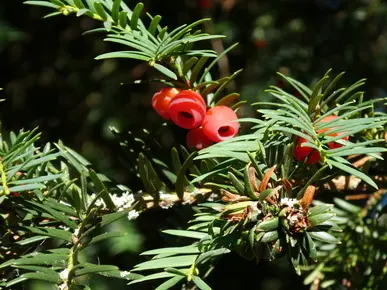
Into the churchyard. A Yew tree has a good crop of berries.
Wednesday – Leominster – The Autumnal Equinox – Shortly after midnight a Tawny Owl hoots close by. A few minutes later another hoots some distance away. They continue for some minutes before a female Tawny gives a few kewick kewick calls.
Leominster – Mid morning brings bright sunshine although banks of dark clouds are moving across the sky. A breeze comes from the northwest. To the Grange. Leaves are turning brown rapidly on the Verdun Oak. This is worrying as I reported extensive honey fungus on this tree several years ago. Some branches are still in full leaf whilst a large number of others are completely dead looking. Through the churchyard. Tiny gnats dance in beams of sunlight. A Speckled Wood butterfly sunbathes. A Blackbird chunters within the depths of a voluminous Yew.
The sun disappears as I walk through the Millennium Park. Into the orchard. There are still only a few Michelin and Broxwood Foxwhelp on the ground, probably not enough to warrant collection yet.
Sunday – Leominster – Last night the Harvest Moon shone brightly. In the early morning, the sky is a mixture of mottled cloud and horse tails. A little later the cloud has thickened and is now covering the vast majority of the sky. The air is cool. Carrion Crows and Jackdaws call. Onto the Grange. A murder of Carrion Crows and Jackdaws explode out of a large Beech with deafening noise. Wood Pigeons flee in every direction. The sun emerges behind the clouds briefly lighting up the trees and golden light. Over Priory Bridge. Below the River Kenwater remains clear and shallow. A Dipper is on the edge of the water where it is thought the Old Priory Bridge stood.
The market is smaller than recent weeks. It is mainly toys, clothes and tasteless ornaments. Back to Ridgemoor Bridge. The River Lugg is flowing slowly and the water level is low. Spits of rain fall. There are few Pond Skaters on the water. The sky darkens to the north.
Home – I harvest some callaloo leaves. I need to remove the plants soon although doubtless many seeds will have dropped and will sprout in their hundreds in Spring. A single chard plant is growing well, I ought to sow some more soon to try and get them established before winter. Very few tomatoes remain on the vines now.
 from 1939-1981. The house became the administrative offices of the works.
 Conifer covered hills rise to the west. Across the Glyn Neath Road is the Neath Canal. A track of large cobbles leads to a cast iron canal bridge. A Grey Wagtail flies off. To the north is Rheola Aqueduct, a small aqueduct just a few feet high, carrying the canal over Rheola Brook which flows from the Rheola Pond to the Afon Nedd/River Neath which flows a short distance away. The sound of traffic on the A465 is ever present.
 Willowherb, Himalayan Balsam and a very large patch of Japanese Knotweed. Crugiau lock is also rotting away. Crugiau Bridge is slowly disappearing under Ivy. A large concrete structure is all that is left of a railway bridge that took a line into the aluminium works.
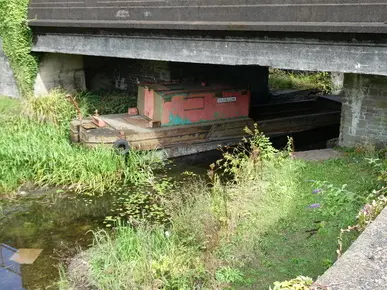 is on the rocks below. A path runs down from the road and under the larger road bridge carrying the A465. The River Dulais is turned by an old weir and then enters the Afon Nedd. Grey Wagtails bob up and down the weir. An aqueduct carries the canal across the Afon Nedd. On the other side is a railway viaduct built in 1852 by Brunel for the Vale of Neath Railway. The line closed for passengers in 1964 and to mineral freight shortly after. A road bridge takes Station Road across the canal. A lock is to the north of the bridge; it is in a ruinous state. A wide overflow channel runs around a small patch of land. Beside the lock is the former lock keeper’s house, now the Royal British Legion. Under the bridge is an old canal barge, Brinklow. Canal Side, Ochre Y Gamlas, is a row of houses and a Wesleyan Methodist chapel of 1901, now a residence. A Moorhen squeaks on the canal. Opposite is a modern canal shed with what look like new mooring posts outside.
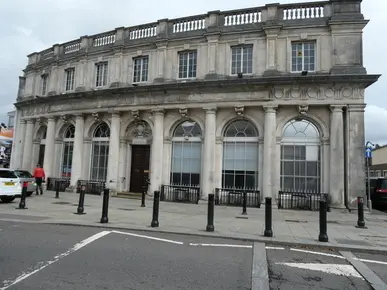 was formed here in March 1881. Nearby is the Old Town Hall. On the opposite corner is The Angel pub of 1905, now Castell-Nedd Arms. Back along The Parade. Victoria Chambers is a cocktail bar. A large former bank seems to be empty. Behind these buildings is the old market, still in operation. It was built in 1837, enlarged in 1877 and remodelled in 1904. The road dog-legs cutting through what was the cattle market. Modern buildings have replaced those around the old market. Between the main street and the railway is the Maed-yr-Haf, an independent chapel, built in 1769 and rebuilt in 1864. Back on the main street, now Windsor Road is a gently curved former bank built in 1924 as the National Provincial Bank by F C R Palmer and W F C Holden in the Free Classicism style. A short distance away are two more banks, both operating as such, built in the early 20th century. Neath station is modern as is the closed Post Office. Next to it is the old Post Office of 1927. The County Police Station of 1937 is a pub. The road continues with
 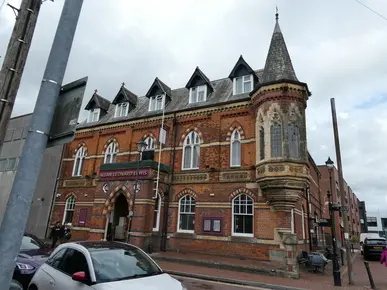 down-market shops in three storey, late Victorian, early 20th century buildings. A passage, constructed by Brunel in 1850, passes under the railway into Commercial Street. A building is listed for having traditional grocer’s fittings but it is completely boarded up. Back up to The Parade.
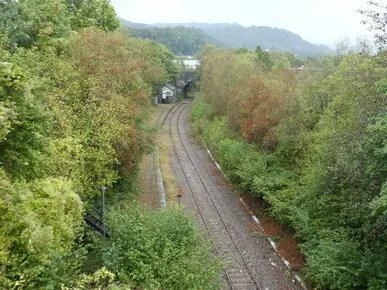 church division, closing in December 1965, is behind a garden centre. A bridge crossed the Neath Canal which is rush filled with the requisite supermarket trolley and traffic cones. One of the Spearworts growing in the water has yellow
 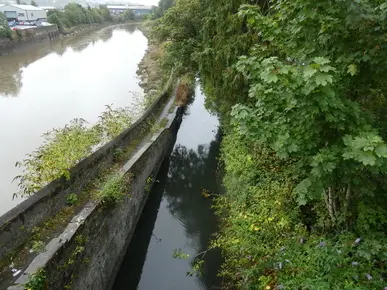 flowers. Opposite is the Moose Hall, a happy-clappy church and the Neath Athletic Rugby Football club. A footbridge crosses the Afon Nedd which is tidal here, the Tennant Canal, the very busy A465, the railway line and Neath Abbey Road before descending to the local college. To the south of the college stood a Roman fort, Nidvm. An Auxiliary fort first built in around 74CE from earth banks and wooden structures. It may have been garrisoned by perhaps 500 auxiliary troops and was abandoned in around 125CE, but re-occupied around 140CE when it was rebuilt in stone. The railway lines is the Swansea-Neath Low Level which closed in 1964 for passengers but was used for minerals until 2022. Below is a red signal still lit and up the track is the signal box. Beneath the bridge is an older river bridge erected in 1790s to replace an earlier bridge at this historic river crossing. A timber bridge was recorded near here by John Leland in the 16th century, a later bridge being of timber and stone. The bridge was designed by David Edwards, son of the famous bridge builder Revd William Edwards of Pontypridd. A few Mallard are on the river. A Little Egret flies downstream and lands on the muddy bank. Upstream is a rather rusty railway bridge carrying the London-Swansea line and a bridge carrying the B4434.
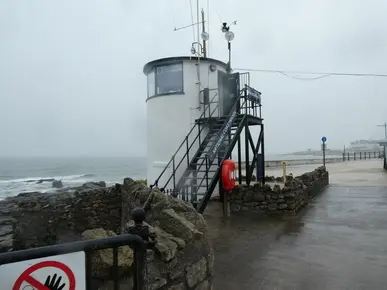 Name dates from 1911 when it was used by Jennings & Co, timber importers. The old customs house is a small sandstone building constructed in 1867. The lifeboat station and coastguard lookout stand at the beginning of the harbour arm. The lookout tower is believed to have been first placed here in the 1830s and this building was firs constructed in 1867. At the end of the breakwater is the lighthouse built 1866 by Messrs Stephen of Bristol. It is a tapered hexagonal cast-iron tower, painted black and white on a
 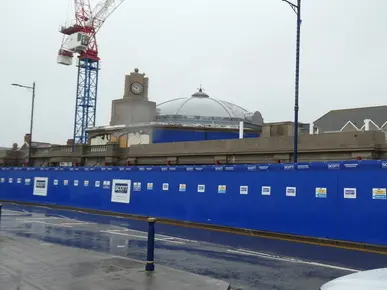 stone plinth. The lantern was replaced following destruction in storm of 1911. Visibility at sea is reduced by the rain. The sea is moderately rough. Two speeding zodiacs bounce violently on the waves.
 Callaloo are slowly being removed and mainly fed to the hens. The Dwarf French Beans has cleared. Winter Rye is broadcast across what was the potato bed this year.
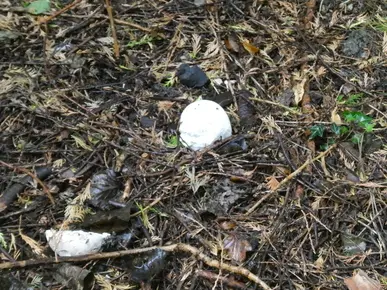 There was to be an orchard clear-up yesterday but I cannot see any difference. It had been decided that strimmers are not to be used, scythes only. I cannot use a scythe as it is all hip movement, so there is little point in me getting involved.
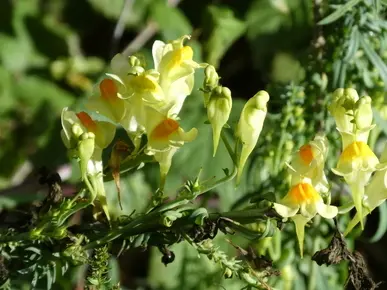 Primrose. There is however a profusion of red berries – Guelder Rose, Haws and Rose Hips. Around the islands in the Sailing Bay are Mallard, a few Tufted Duck, Greylags, a large number of Canada Geese and a couple of Little Egrets. Around the corner, on the meadow bay, are many more Canada Geese and a few Coot.
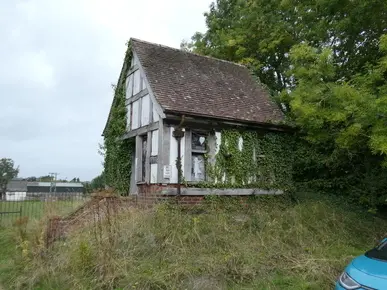 – Weobley – It has been some years since my last visit to the Herefordshire village to the west of Leominster. The sky is overcast and the morning is the coolest this autumn. The Domesday Book spelled the name Wibelai and was held by a Saxon nobleman named Eadwig Cild before the Norman Conquest. After the Conquest, it was granted to Roger de Lacy. The Domesday Book mentions a priest, evidence that a late Saxon church stood here at the time. The small building by the car park is slowly deteriorating under Ivy. It was formerly the water pumping station and is still owned by Dŵr Cymru. Across Meadow Street is the Manor House, a 16th century hall with gabled wings.
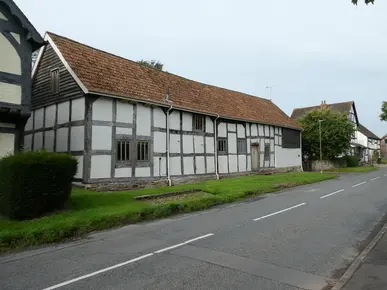 Around the corner is the old Vicarage, a mid 15th century axial hall with the service and solar bays under one roof. Two gables were added a century later. Next to the hall is a 17th century four bay threshing barn used as the tithe barn. Beyond heading out of the older part of the village, are more 17th century houses.
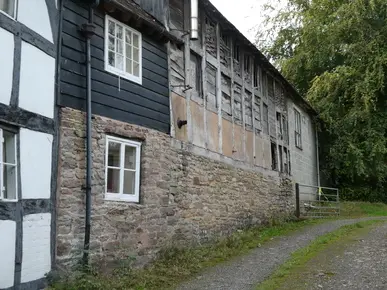 a butchers with a 16th century barn behind, formerly the abattoir whose upper floors have open wattle to provide ventilation. On a junction is the old forge dating from the 16th century. Across the road, in Chamber Walk or Mill Bank, is the mid 19th century former corn mill, now residences. The mill was built with four storeys with a fifth added some years later. A ground floor dwelling has done wonderful wooden models in the window. Beyond the mill buildings is an iron water pump. Along the road is the Hall of Remembrance. It was the Territorial Army Hall. Renamed the Hall of Remembrance and donated to the village by Colonel Leather in memory of his wife after her death in 1928. It was the community centre until 1991. Next to it is Chamberwell Cottage, a “Vote House” where MPs were elected by the small number of voters. The name is believed to refer to a chamber which stored potable water from an unpolluted well. The Marlbrook which ran through the village was polluted by a number of industries. The lane leads out of the village.
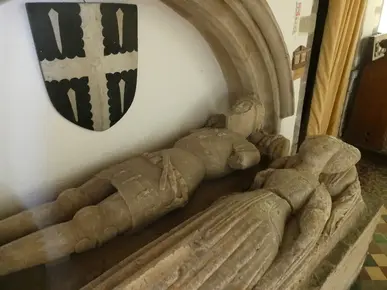 who became lord of the manor in 1091. It was partially rebuilt in the 14th century with a detached tower which was attached in the 15th century. The spire was rebuilt in
 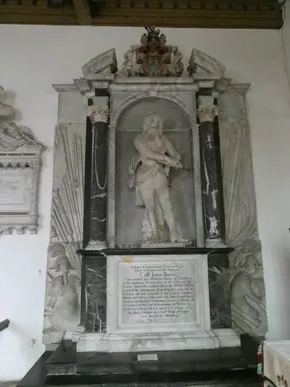 1675 and again in 1898. The church was restored in 1865 by West of London then a year later by Nicholson. The font is 14th century. The chancel screen was installed in 1912. The reredos is by Thomas Gamier Parry. In the chancel is a chest tomb with a effigy of a knight believed to be Sir Walter Devereux who married Agnes Crophull, heiress of Weobley Manor, when she was eleven. He died at Pilleth fighting Owain Glyndŵr. Another tomb has effigies thought to be Agned Crophull and her third husband John Marbury. She died in 1433, he in 1437. The reredos is by Thomas Gamier Parry. The most impressive monument is a large edifice near the altar in memory of Colonel John Birch. He was a prominent Civil War commander on the Parliamentary side and served as an MP on 11 occasions. Birch was co-commander of the Parliamentary force that captured Hereford in 1645 and was later named Governor of Hereford. In 1646 he headed a force that besieged and captured Goodrich Castle. In the side chapel, the Verdin Chapel, is a decorated stone coffin lid with a foliated cross, crozier and mitre. It is 13th century and commemorates Hugh Bissop, who was not a bishop and the presence of the mitre and crozier may be a mediaeval pun. The organ is by Ingram & Co. It was installed against the congregation’s wishes in 1908. The tower has a ring of six bells. A bell stands at the end of the nave taken down in 1963 but not rehung as there is a fault in the top surface. It dates from the reign of Queen Anne. It has a worn inscription:
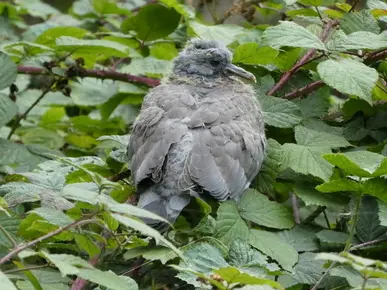 Sunday – Leominster – Another cool and largely cloudy morning. A couple of Robins sing, another ticks. Wood Pigeons clatter in the trees. Grass is green and growing again on the Grange after some months of yellow dormancy. Down to the River Kenwater. A flock of Wood Pigeons flies over heading east. The River Kenwater looks unchanged. The majority of berries on the large bramble patch by the Priory Bridge are finished. A scruffy Collared Dove fledgling sits on the brambles. A Carrion Crow croaks from a tree on Pinsley Mead, its call echoing off the Old Priory hospital. The water level in the River Lugg has fallen again and the gravel bank has re-emerged.